

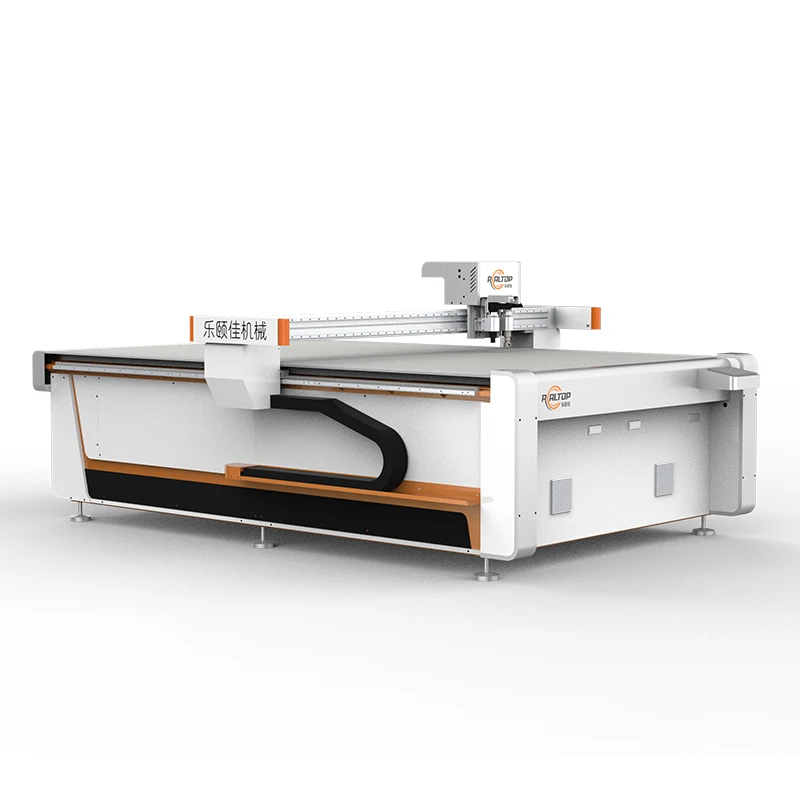
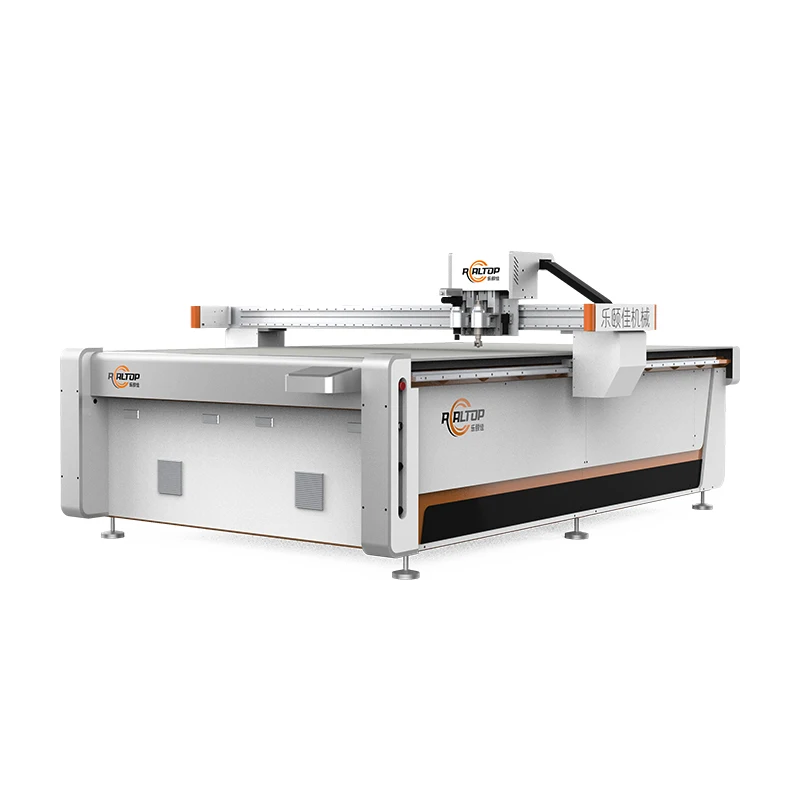
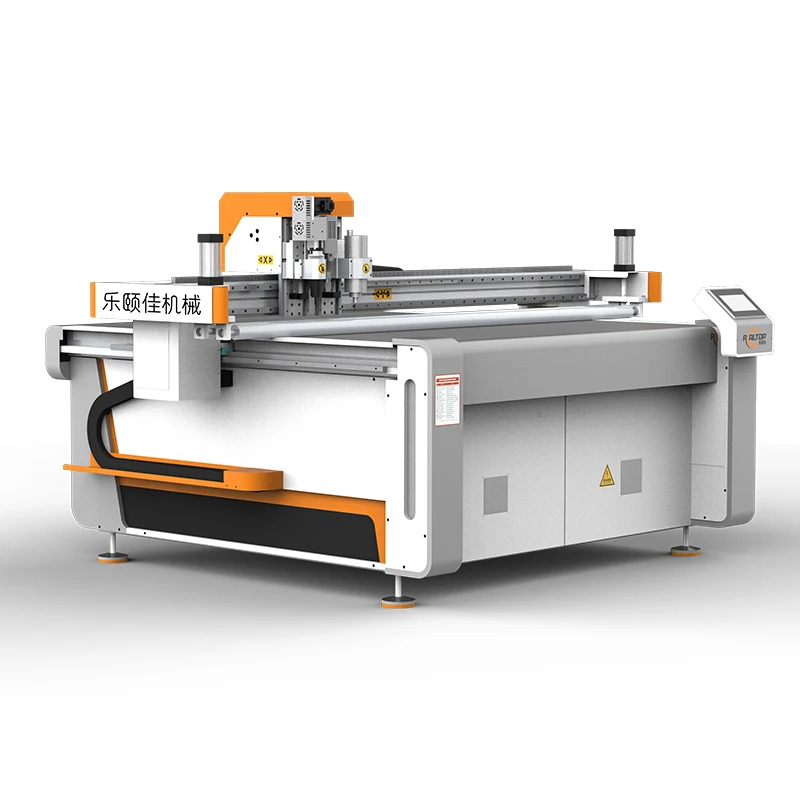
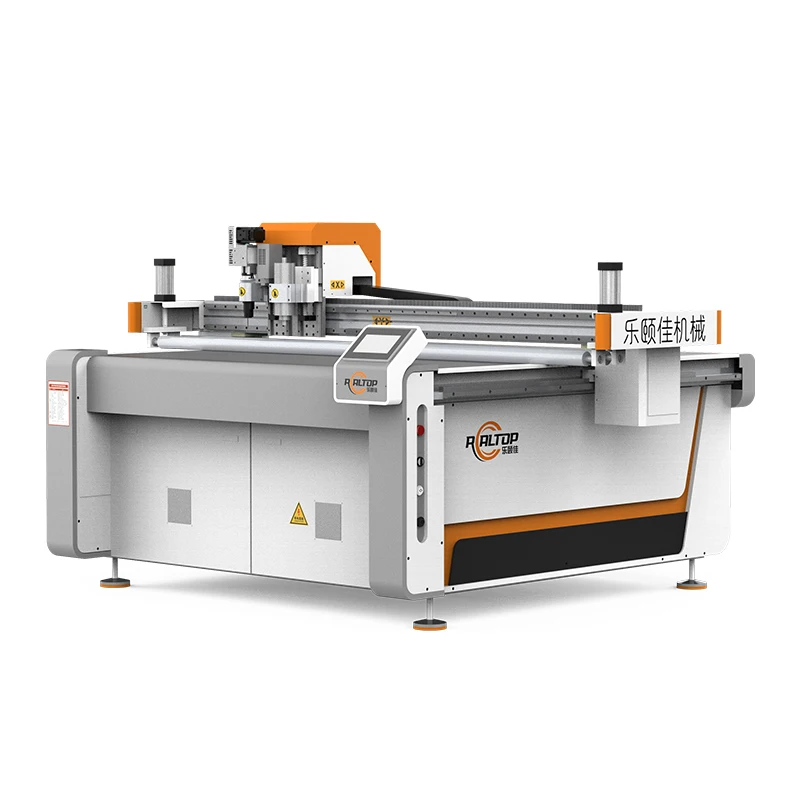
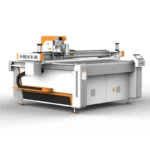
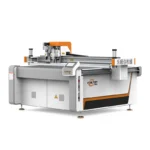
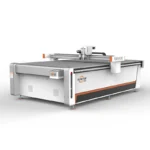
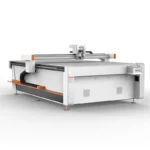
CNC Box Cutter 1600×1200mm Auto Creasing Cutting Machine – Factory Supply
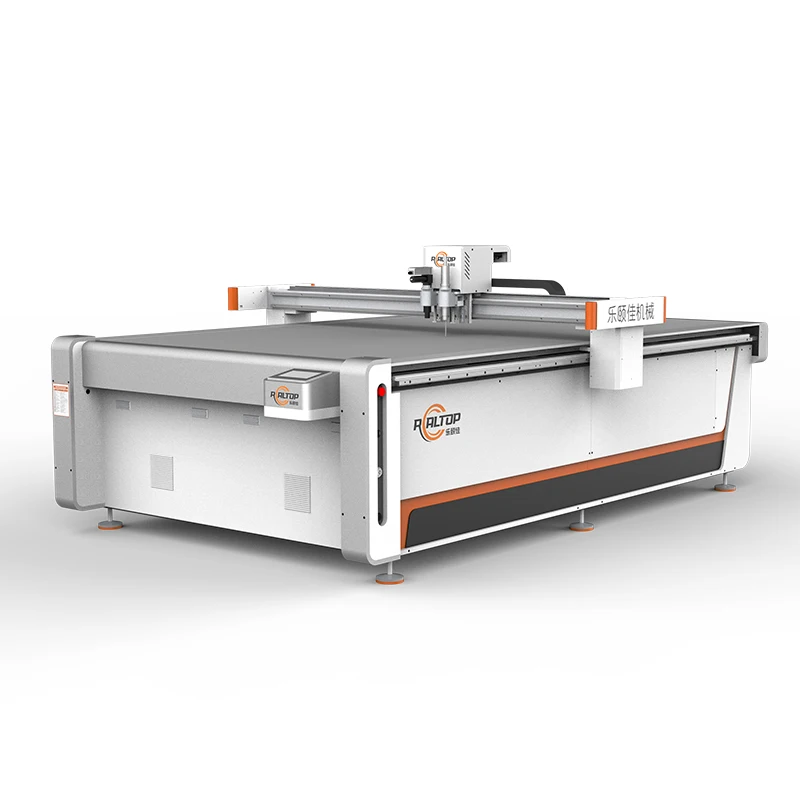
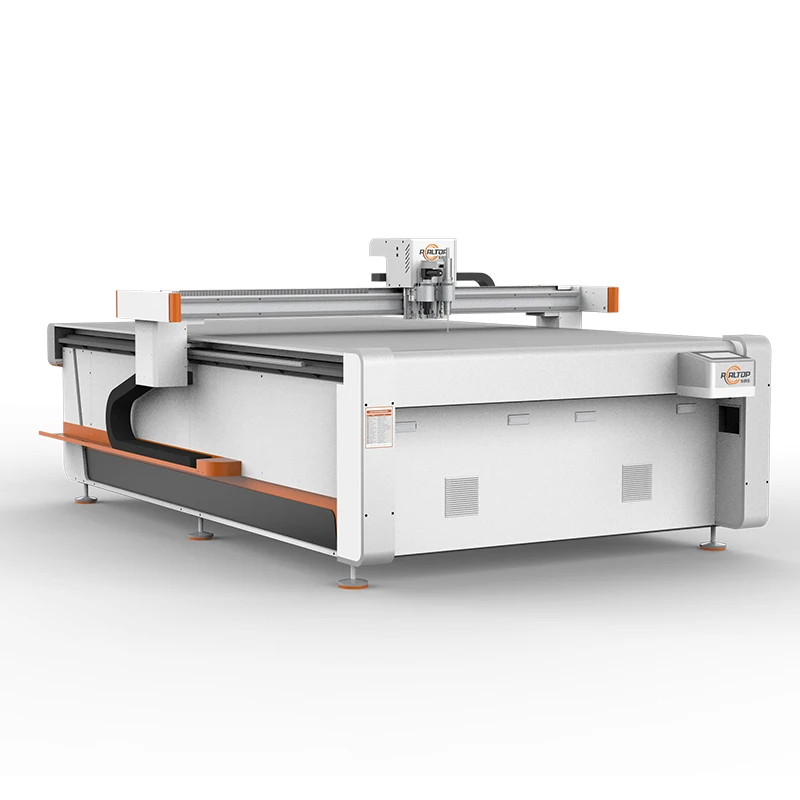
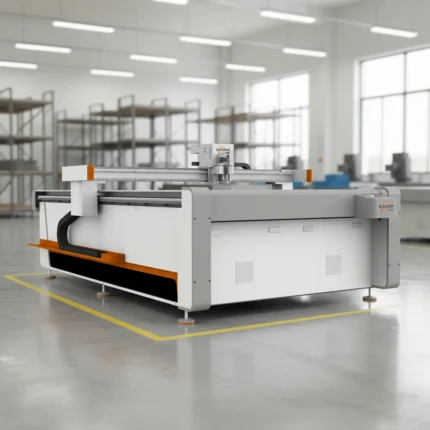
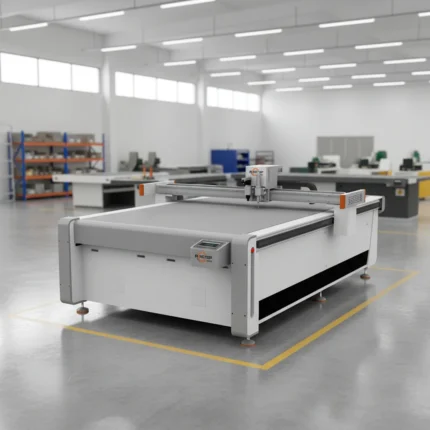
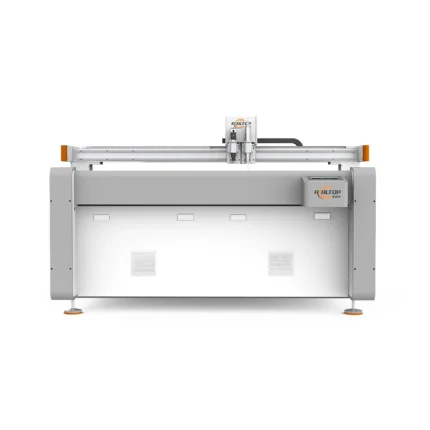
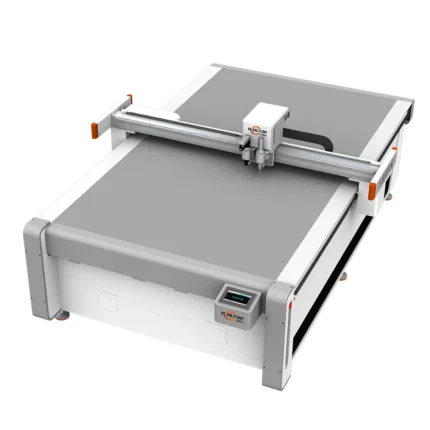
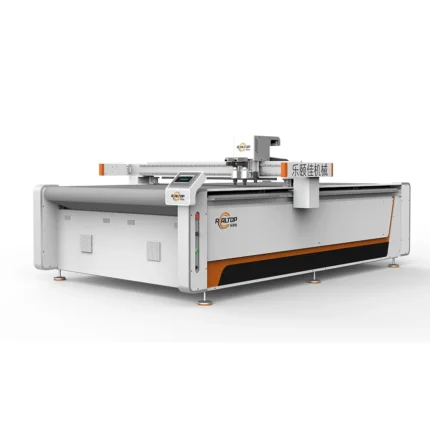
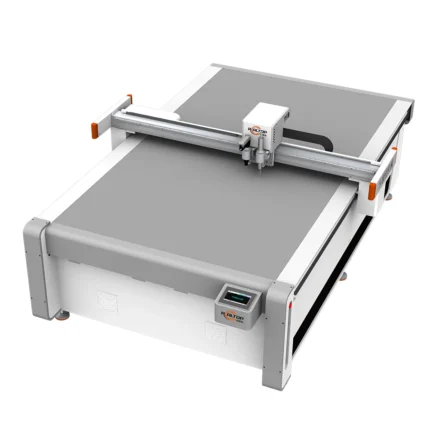
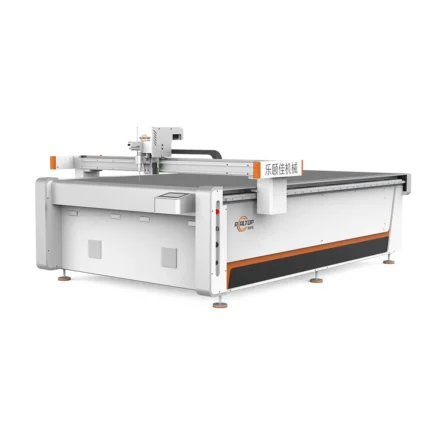
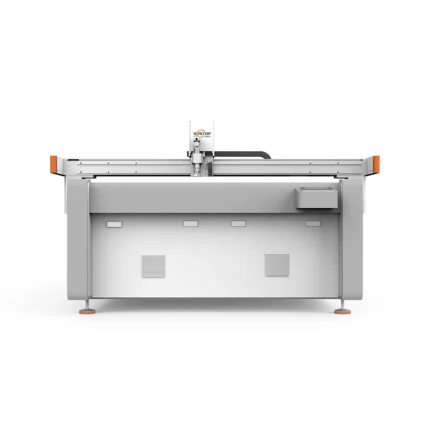
RT-D2516/RT-S2516 CNC Digital Cutting Machine, 1600×2500mm Working Area, 9kW — configured with Swiss imported oscillating knife and creasing wheel for clean, burn-free edges on cardboard, corrugated board and flexible materials.
- Delta servo motor with ≤0.1mm repeated accuracy and 200-800mm/s cutting speed
- Aluminum vacuum table with zoned adsorption for stable small-part cutting
- CCD camera contour recognition available for printed mark tracking
Sample cutting on your own material before commitment ensures the knife configuration matches your exact board grade and thickness.
Precision Blade Configuration — Tool head selection matched to substrate density and thickness rather than defaulting to a single oscillating knife, preventing ragged edges on corrugated board and crushed foam on honeycomb panels.
Technical Specifications
| Parameter | Value |
|---|---|
| Product Type | CNC Digital Cutting Machine |
| Working Area | 1600 × 2500 mm |
| Overall Dimensions | 3450 × 2300 × 1250 mm |
| Rated Power | 9 kW |
| Table Type | Flat working table with auto-feeding conveyor |
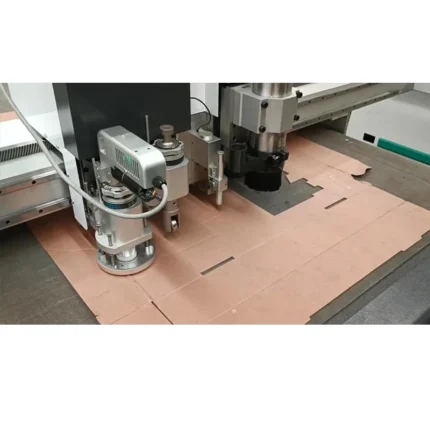
| Tool Head Options | Swiss imported vibrating knife, oscillating knife, pneumatic knife, circular knife, V-cutting knife, drag knife, creasing wheel, dotted line knife, punching, brush |
| Translational Velocity | 800–2000 mm/s |
| Cutting Speed | 200–800 mm/s (varies with material type and thickness) |
| Cutting Thickness | Up to 100 mm (varies with material density and structure) |
| Repeated Accuracy | ≤0.1 mm |
| Transmission System | Digital servo motor, linear guide, synchronous belt, ball screw |
| Servo Motor | Delta servo motor (optional: domestic or Japanese alternatives) |
| Vacuum Pump | 7.5 kW |
| Conveyor Belt | Germany-imported conveyor belt |
| Linear Guide | Taiwan Hiwin rail |
| Control Panel | Touch screen with multi-language support |
| Software Compatibility | PLT, DXF, AI and other vector formats |
| Visual Positioning Options | Small CCD mark point, panoramic camera recognition, projection positioning |
| Vacuum Table | Aluminum air box platform with integrated or split-box zoning |
| Frame Construction | Welded thick-walled seamless steel, high-temperature tempered, CNC machined |
| Instruction System | HP-GL compatible format |
| Voltage | 380V ±10% |
| Safety Devices | Infrared induction blocking, anti-collision, emergency stop |
Application Suitability
| Application | Material or Output |
|---|---|
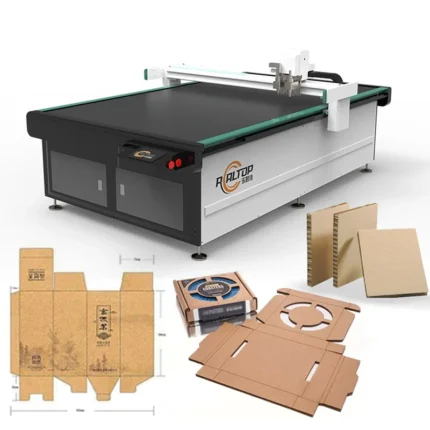
| Packaging sample making | Cardboard, honeycomb cardboard, corrugated cardboard with creasing wheel |
| Plastic packaging prototyping | PVC, PP, PE folding carton stock |
| Leather and footwear cutting | Natural leather, PU synthetic, shoe lining and upper material |
| Textile and garment batch cutting | Clothing cloth, non-woven fabric, carpet, sponge |
| Gasket and seal fabrication | Rubber, PTFE, ETFE, fiber composite gasket sheets |
| Advertising and signage finishing | Self-adhesive vinyl, sticker film, printed corrugated display boards |
| Automotive interior trimming | Foam board, EVA, XPE, PU padding, headliner fabric |
| Composite panel processing | Fiberglass mat, carbon fiber pre-preg, multi-layer sandwich panels |
What Happens When Tool Head Selection Is Left to Default
Matching the blade type to the substrate prevents edge compression, delamination, and unscheduled tool changes on the shop floor.
I once specified a single-head vibrating knife on a packaging sample machine for a carton converter who ran 3 mm corrugated daily. Within three months the blade edge degraded prematurely, positional accuracy drifted, and the machine was stopping for blade swaps more often than it was cutting [NEED_CITE: tooling wear patterns across corrugated grades]. The root cause was not the machine itself — it was that the tool head was never matched to the flute structure of the board. A CNC Digital Cutting Machine for packaging work needs its tool head specified against the actual material stack, including flute profile and any coating or lamination on the surface. This RT-D2516/RT-S2516 platform offers creasing wheels, V-cutting knives, pneumatic knives, and drag knives alongside the standard oscillating knife, which means the buyer selects the right tool for each substrate rather than forcing one blade through everything.
Blade-to-Material Matching for Packaging and Flexible Substrates
The physical knife cutting process produces a clean, burr-free edge with no thermal discoloration or burnt residue — a result that laser cutting cannot replicate on corrugated cardboard or foam-core panels. The RT-D2516/RT-S2516 CNC Cutting Equipment manufacturer platform supports over ten distinct tool head options, each engineered for a specific material response. A creasing wheel compresses the fiber along the fold line without severing it, preserving the structural integrity of the carton blank. A pneumatic knife handles thicker foam and sponge where an oscillating blade would deflect. When the correct tool is loaded, edge quality is determined by the blade geometry, not by operator guesswork.
Vacuum Zoning and Its Role in Holding Small Parts Flat
The 7.5 kW vacuum pump feeds an aluminum air box platform that supports either integrated or split-box zoning. Split zoning matters when the cutting nest includes small parts — for example, a carton sample sheet with multiple die-cut windows and interior cutouts. Without zone isolation, the vacuum pulls air through exposed areas of the table where material has already been removed, and suction drops at the remaining workpiece [NEED_CITE: vacuum table zoning principles for flatbed cutters]. The split-box design on this machine keeps full suction across the active cutting zone regardless of how many parts have been removed from the surrounding sheet.
Reading the Specs: What the Numbers Mean on the Floor
The 1600 × 2500 mm working area accommodates full-size corrugated sheets and multi-layer fabric lays without repositioning. The 800–2000 mm/s translational velocity governs how fast the head moves between cut paths — the non-cutting travel that accumulates across hundreds of small parts in a nesting layout. Cutting speed of 200–800 mm/s is the actual blade-through-material rate, and where a given job falls on that range depends on substrate density and layer count. Repeated accuracy of ≤0.1 mm, driven by Delta servo motors on Taiwan Hiwin linear rails, ensures that a registration mark hit on the first piece in a run is still within tolerance on the five-hundredth piece. The HP-GL compatible instruction system accepts PLT, DXF, and AI files directly, so design files from common packaging CAD software load without intermediate conversion.
The Cost of Skipping the Configuration Conversation
When a buyer specifies a flatbed cutter on working area alone and leaves the rest to the supplier, the consequences show up weeks after commissioning. Insufficient vacuum zoning causes small gasket parts to lift during the final pass, ruining the piece and the blade. A machine shipped without confirming voltage and plug type sits crated while transformers are sourced locally [NEED_CITE: voltage mismatch incidents in industrial equipment export]. Software that cannot open the buyer’s native DXF or PLT files forces operators into manual re-drawing, erasing any speed advantage the machine was supposed to deliver. These are not theoretical risks — they appear repeatedly in post-sale service logs.
Why Source This CNC Cutting Equipment Manufacturer
The RT-D2516/RT-S2516 is designed and built in-house, covering both knife and laser cutting technologies under one engineering team, so the cutting method is matched to the material rather than forced into a single process. Tool head and table configuration are specified per material and production volume before the order is confirmed. CCD camera positioning is available for printed contour work on packaging prototypes and signage panels. Software compatibility — including file format, nesting workflow, and control language — is verified before shipment. Sample cutting on the buyer’s own material is completed and documented before commitment, providing a physical benchmark rather than a catalog claim.
Documentation & Verification
- Machine specification sheet listing confirmed tool heads and vacuum zoning layout
- Electrical schematic with voltage, frequency, and plug type matched to destination
- Sample cutting report produced on the buyer’s own corrugated or composite material
- Factory test record documenting positional accuracy across a full working area sweep
- Software license with file format compatibility note for PLT, DXF, and AI workflows
- Spare parts list identifying consumable blades, belts, and vacuum seals with part numbers
Installation, Commissioning & Support
- Floor loading assessment based on the 3450 × 2300 mm overall footprint and 9 kW rated power draw
- Dedicated 380V ±10% circuit with confirmed frequency and breaker rating before machine arrival
- Conveyor belt tensioning and vacuum pump commissioning during first-day startup
- Touch screen language configuration and software nesting parameter setup on site
- Operator training covering tool head changeover between creasing wheel and oscillating knife
- Scheduled linear rail lubrication and synchronous belt inspection intervals documented in manual
Before Requesting a Quote
To match the right configuration to your production environment, provide the material types and thicknesses you run most frequently, the typical sheet or roll dimensions, and your daily volume target. Include your local voltage and frequency standard along with the preferred control panel language. If you work with printed materials requiring contour cutting, specify whether your registration marks are small fiducial points or full-panel printed borders so the correct visual positioning system can be selected.
Frequently Asked Questions
Q: How does knife cutting compare to laser cutting on corrugated packaging board?
A: Knife cutting produces no heat, so there is no burnt edge, no discoloration, and no fume extraction requirement. On corrugated and honeycomb board, the blade slices through flutes cleanly while a laser tends to char the liner. For packaging sample making where edge appearance and structural integrity matter, the physical blade process is the standard choice.
Q: How do I choose between an oscillating knife and a creasing wheel for carton work?
A: The oscillating knife severs the board to create the blank outline, while the creasing wheel compresses the fold lines without cutting through. A typical carton sample job uses both tools in the same cycle — the oscillating knife for the perimeter and internal cutouts, the creasing wheel for every fold. Both heads can be mounted on the same tool carriage.
Q: What determines where my cutting speed falls between 200 and 800 mm/s?
A: Material density, thickness, and layer count set the practical cutting speed. Thin sticker film cuts near the upper end, while 10 mm honeycomb cardboard requires a slower pass to prevent flute crushing. The auto typesetting software adjusts speed per cut path based on the material profile loaded into the job file.
Q: How does split-box vacuum zoning affect small part cutting stability?
A: When the table is divided into zones, suction concentrates under the active cutting area instead of leaking through exposed sections where material has already been removed. This prevents small parts from shifting during final cuts, which is critical when nesting dozens of gasket or label pieces on a single sheet.


Related products
2026 Digital Flatbed Cutting Plotter Auto Corrugated Box Die Cutter
Product Introduction
Digital Flatbed Cutting Plotter 2026, ideal for auto corrugated box die cutting, offering precision and efficiency for professional packaging production.Specifications
| Type | Digital Flatbed Cutting Plotter |
| Model | 2026 |
| Application | Auto Corrugated Box Die Cutting |
| Function | Precision Cutting & Plotting |
Automation CNC Pizza Box Machine 2026 Rotary Die Cutting
Product Parameters
| Type | Automation CNC Pizza Box Machine |
| Model Year | 2026 |
| Cutting Technology | Rotary Die Cutting |
| Operation | Automated CNC Control |
Introduction
This 2026 Automation CNC Pizza Box Machine features advanced rotary die cutting technology, ensuring precise and efficient pizza box production. With automated CNC control, it offers high productivity and accuracy for professional manufacturing needs.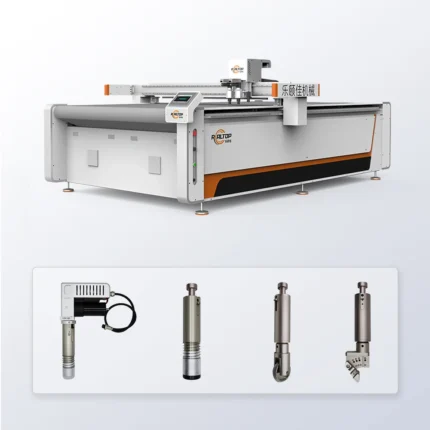


Digital CNC Cardboard Cutting Machine 2026
Product Introduction
High-precision Digital CNC Cardboard Cutting Machine 2026, ideal for efficient cardboard processing with advanced CNC technology, ensuring precise and fast cutting performance for various packaging and craft applications.
Key Specifications
| Model | 2026 |
| Type | Digital CNC Cutting Machine |
| Material | Cardboard |
| Feature | High Precision, Efficient Cutting |

Realtop 2026 Digital Box Cutter High-Speed Corrugated Board
Product Introduction
Realtop Digital Box Cutting Machine 2026 is a high-speed solution for corrugated board cutting, designed for efficient and precise box production in manufacturing settings.Key Specifications
| Model | 2026 |
| Type | Digital Box Cutting Machine |
| Application | Corrugated Board |
| Feature | High-Speed Cutting |
商品评价
There are no reviews yet.