




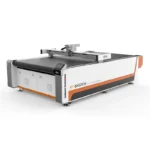
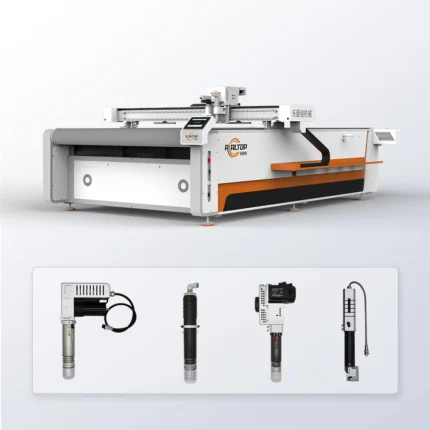
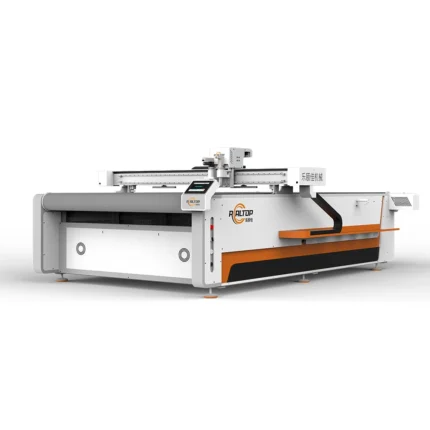
Realtop-2516 CNC Flatbed Plotter Cutter for Fabric – Laser Cutting and Engraving
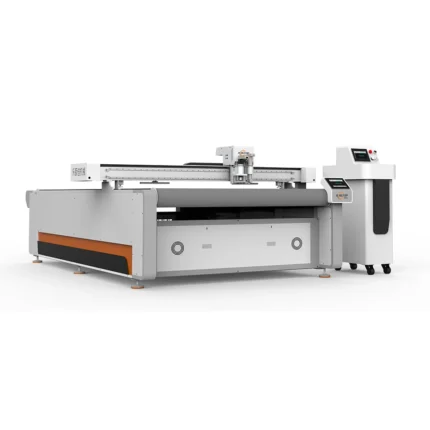
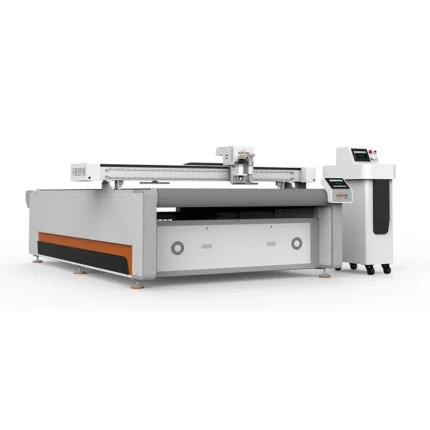
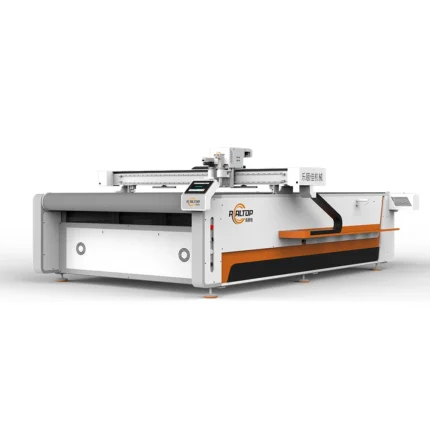
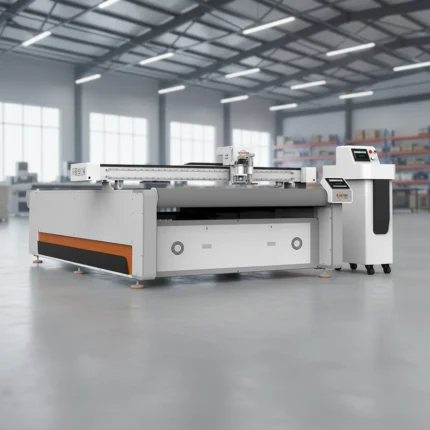
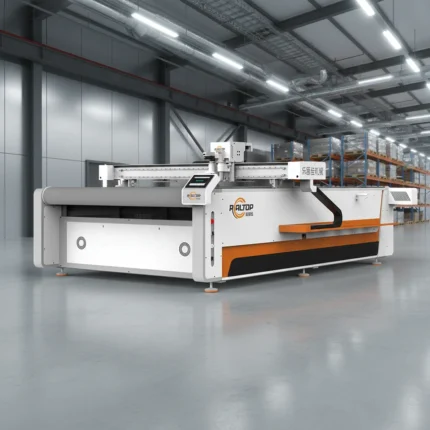
RT-D2516/RT-S2516 Cloth CNC Cutting Machine, 1600×2500mm Working Area, 380V — configured with Swiss imported oscillating knife and aviation aluminum vacuum table with zoned suction for even hold across the full bed. Designed for fabric, leather and composite processors evaluating knife cutting over CO2 laser to avoid thermal edge-sealing and depth limitations on multi-layer materials. Translational speed reaches 800–1200 mm/s with repeated accuracy ≤0.1 mm. Sample cutting on your own material, voltage and language confirmed before shipment, and software file format compatibility verified to match your nesting workflow.
Cutting Method Matched to Material — REALTOP designs both knife and laser systems in-house, so the RT-D2516/RT-S2516 oscillating knife platform is specified by material behavior rather than forcing a thermal process onto substrates that demand cold cutting.
Technical Specifications
| Parameter | Value |
|---|---|
| Model | RT-D2516/RT-S2516 |
| Product Type | CNC Flatbed Oscillating Knife Cutting Machine |
| Working Area | 1600 × 2500 mm |
| Overall Dimensions (L × W × H) | 3450 × 2300 × 1250 mm |
| Rated Power | 9 kW |
| Voltage | 380V ±10% (frequency to be confirmed: 50/60 Hz) |
| Vacuum Pump | 7.5 kW |
| Working Table | Flatbed vacuum table with aviation aluminum inner-wind structure and high-density felt |
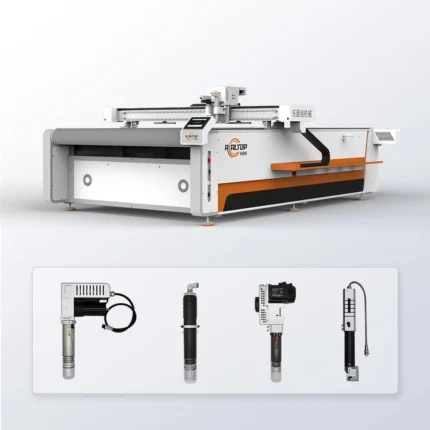
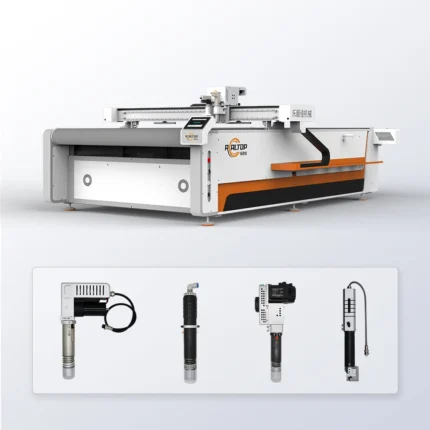
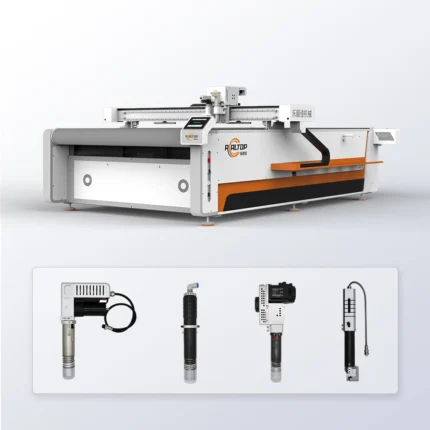
| Multifunctional Tool Head | Swiss imported knife — vibration full cutting, half cutting, cursor location |
| Modular Tool Holder | Compatible with round knife, marking pen, auto feeder |
| Translational Speed | 800–1200 mm/s |
| Repeated Accuracy | ≤0.1 mm |
| Transmission System | Digital servo motor, linear guide, synchronous belt, ball screw, rack and pinion |
| Servo Motor | Panasonic (Delta option — verify against build sheet) |
| Linear Rail | Taiwan Hiwin |
| Auto Feeding | Included — Germany imported conveyor belt |
| Safety Device | Infrared sensors |
| Instruction System | HP-GL compatible format |
| Control Language | English, Russian, Italian, Chinese (other languages customizable) |
| Certification | CE (declaration number to be confirmed) |
Application Suitability
| Application | Material or Output |
|---|---|
| Garment and fashion fabric cutting | Single-ply and multi-layer woven, knit and technical textiles |
| Footwear and leather goods | Natural leather, PU/PVC synthetic leather, shoe uppers and bag panels |
| Automotive interior soft trim | Sponge composite leather, foam-backed fabrics, headliner and door panel materials |
| Home furnishing textiles | Upholstery fabric, curtain panels, cushion and mattress ticking |
| Gasket and seal fabrication | Rubber, silicone, PVC and soft glass sheets |
| Packaging sample making | Carton board, corrugated samples and folding carton prototypes |
What Happens When Laser Edge-Sealing Becomes the Problem, Not the Solution
An oscillating knife eliminates thermal edge distortion on synthetics and multi-layer composites where CO2 laser heat melts coatings, fuses fabric plies together, or leaves a hardened bead that downstream sewing operations cannot handle.
In珠三角 workshops cutting TPU-coated composite fabrics, I have watched laser-cut edges seal so aggressively that the coating melts back into the weave, creating a stiff ridge that cracks during garment assembly. The RT-D2516/RT-S2516 cold-cut approach preserves the original hand-feel and drape of the material. For multi-layer lay-ups, a vibrating blade slices through all plies simultaneously without fusing them at the cut line [NEED_CITE: thermal effects on TPU-coated textiles during CO2 laser cutting]. This is the fundamental reason a CO2 and fiber laser cutting machine manufacturer will still recommend a knife table for specific material families.
Knife Versus Laser: Where the Decision Line Falls
Material processors evaluating a laser cutting and engraving equipment factory often assume a CO2 system handles every soft material in the catalog. The reality is more conditional. Fabrics with thermoplastic coatings, multi-layer lay-ups intended for downstream sewing, and foam composites that crush under thermal load all favor oscillating knife technology. The RT-D2516/RT-S2516 fills this role on the same factory floor where a laser unit handles acrylic, wood or engraving tasks — letting the production manager assign each job to the correct process rather than compromising on one.
Edge Quality and Downstream Workflow Consequences
The cut edge determines what happens next. A laser-sealed edge on polyester prevents fraying, which is desirable for banner and flag work. But that same sealed edge on a laminated automotive headliner fabric creates a hard line that shows through the visible surface after forming. The Swiss imported oscillating knife on this system produces a clean shear cut without thermal alteration, keeping the material ready for adhesive bonding, stitching or thermoforming without secondary edge treatment [NEED_CITE: edge quality requirements for automotive interior soft trim assembly].
Reading the Specification Sheet Beyond the Working Area
The 1600 × 2500 mm working table accommodates full-width fabric rolls and large leather hides, but the aviation aluminum countertop with inner-wind suction structure is the detail that determines whether small nested parts stay flat. Uniform negative pressure across zoned regions prevents material lift at high translational speeds of 800–1200 mm/s. The 7.5 kW vacuum pump generates the suction head required for dense multi-layer lay-ups. Repeated accuracy of ≤0.1 mm, driven by Taiwan Hiwin linear rails and Panasonic servo motors, ensures that pattern pieces nested tightly together maintain dimensional consistency across the entire cutting field — critical for garment grading where a fraction of a millimeter compounds across dozens of sizes.
The Configuration Mistakes That Surface After Delivery
Selecting a machine based on bed size alone, without matching the tool head to the actual material, leads to ragged edges on technical fabrics or crushed foam cores. The modular tool holder accepts round knife, marking pen and auto feeder attachments, but these must be specified before build — retrofitting a round knife for aramid fabric or a creasing wheel for carton samples after delivery introduces downtime and alignment recalibration. Voltage and frequency must be confirmed for the destination market; the 380V ±10% rating requires matching the local grid, and a 60 Hz supply on a machine wound for 50 Hz alters vacuum pump and servo behavior [NEED_CITE: voltage and frequency standards by export market].
Why Source This Platform From the Same Factory That Builds Laser Systems
REALTOP’s in-house design team engineers both knife and laser cutting systems, which means the recommendation is driven by material science rather than limited to one technology. The RT-D2516/RT-S2516 benefits from shared motion platform engineering — the same welding-process lathe bed and imported milling machine machining that supports their laser gantry systems. Buyers receive sample cutting on their own material before commitment, so edge quality and throughput are verified against real production substrates. Control language, voltage and plug configuration are confirmed at order stage, not discovered at uncrating. Software compatibility with HP-GL format and existing nesting workflows is validated before the machine enters production.
Documentation & Verification
- Factory test record cut on buyer-supplied fabric or composite material before dispatch
- Electrical schematic confirming 380V ±10% rating and destination frequency match
- Tool head and table configuration list matched to specified material type and thickness
- Software licence and HP-GL file format compatibility note for nesting workflow integration
- Sample cutting report documenting edge quality, speed and layer count on buyer material
Installation, Commissioning & Support
- Dedicated 9 kW power circuit with 380V ±10% supply and confirmed 50/60 Hz frequency at site
- Overall 3450 × 2300 × 1250 mm footprint requires level floor with clearance for auto feeder conveyor
- 7.5 kW vacuum pump requires independent extraction path and acoustic consideration for workshop
- First-run parameter calibration on buyer material for knife frequency, vacuum zoning and feed rate
- Operator training on modular tool holder changeover between oscillating knife, round knife and marking pen
- Spare parts list covering Swiss knife blades, Hiwin rail blocks and high-density felt table surface
What to Include With Your Inquiry
Send the specific material type, coating or lamination details, single-ply thickness and intended lay-up layer count. State your local voltage and frequency, preferred control language and the CAD or nesting software currently in use. If your production workflow includes printed contour cutting, note the registration mark format and print repeat dimensions so the system configuration can be confirmed before build.
Frequently Asked Questions
Q: Should I choose knife cutting or laser cutting for my fabric and composite materials?
A: Knife cutting suits materials where thermal edge-sealing is undesirable — TPU-coated fabrics, multi-layer lay-ups for sewing, foam composites and automotive interior trim. Laser cutting seals edges on synthetics, which benefits banner and flag work. The correct choice depends on your downstream assembly process and the specific substrate construction.
Q: How is cutting thickness verified before I commit to an order?
A: REALTOP runs sample cutting on your actual material, documenting edge quality, achievable speed and layer count in a cutting report. The ≤50 mm stated cutting capacity is material-dependent, so verification against your specific fabric density, foam composition or composite lay-up is required before configuration is finalized.
Q: What must be confirmed regarding voltage, language and software before shipment?
A: The 380V ±10% electrical system must match your local supply frequency. Control language is configurable across English, Russian, Italian and Chinese, with other languages available. Software compatibility with HP-GL format and your existing nesting workflow must be validated at order stage to prevent file import issues during commissioning.
Q: How does the vacuum table handle small nested parts without material lift?
A: The aviation aluminum countertop uses an inner-wind structure that distributes suction across zoned regions of the 1600 × 2500 mm working area. The 7.5 kW vacuum pump provides sufficient negative pressure to hold small pattern pieces flat during high-speed cutting, but zone configuration should be matched to your typical nesting layout.
Q: Can I add different tool heads later as my product range expands?
A: The modular tool holder accepts round knife, marking pen and auto feeder attachments. These can be specified at initial order or added later, but alignment calibration is required with each addition. Confirming your anticipated product expansion at the inquiry stage allows the configuration to be planned without production interruption.


Related products
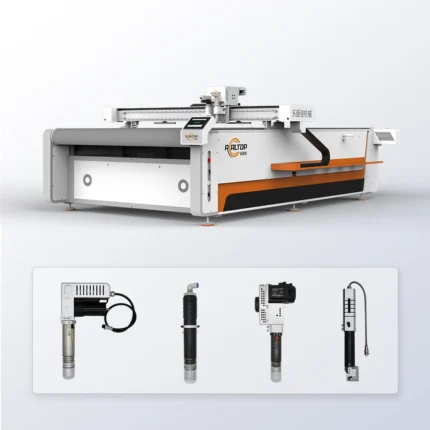
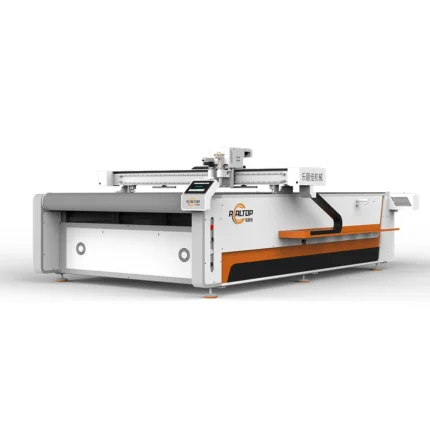
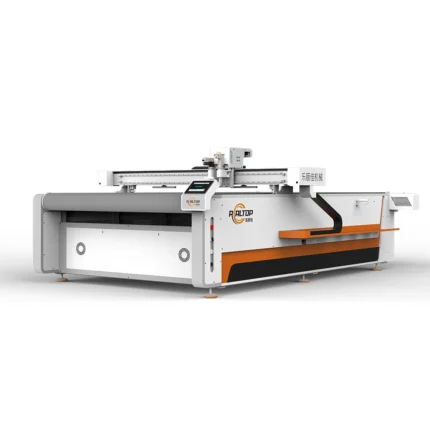
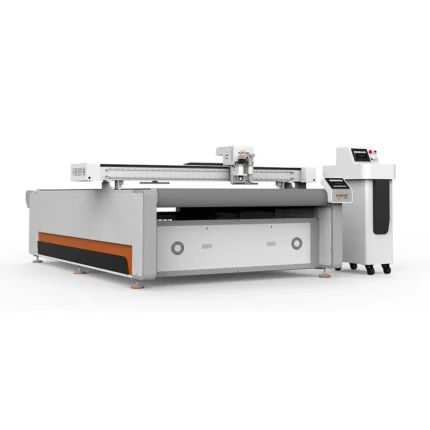
2026 Auto CNC Cloth Cutting Machine High-Precision Fabric Leather Plotter
Product Introduction
2026 Auto CNC Cloth Cutting Machine, a high-precision fabric & leather plotter designed for efficient cutting. Ideal for textile and leather industries with advanced CNC technology.
Key Specifications
| Model | Auto CNC Cloth Cutting Machine 2026 |
| Application | Fabric & Leather |
| Precision | High-Precision Cutting |
| Type | CNC Plotter |
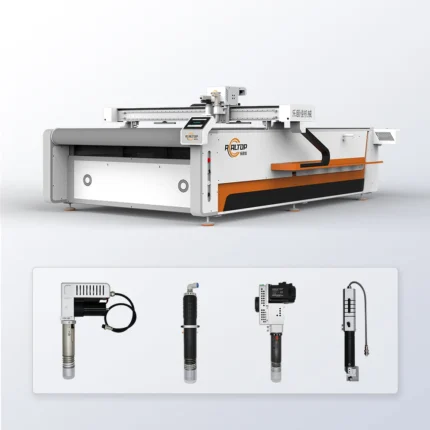
CNC Vibration Knife System 2026 for Polyester Nylon Non-Woven Prepreg
Product Introduction
CNC Vibration Knife System 2026 is ideal for cutting polyester, nylon, non-woven fabrics, and prepreg materials with precision and efficiency, suitable for industrial manufacturing needs.Product Parameters
| Model | 2026 |
| Cutting Technology | CNC Vibration Knife |
| Materials | Polyester, Nylon, Non-Woven, Prepreg |
High Speed Fabric Cutting Machine 2026 Round Oscillating Knife
Product Overview
High Speed Fabric Cutting Machine 2026 with round and oscillating knife for efficient fabric cutting. Ideal for textile manufacturing and related industries.Key Specifications
| Cutting Type | Round & Oscillating Knife |
| Model Year | 2026 |
| Application | Fabric Cutting |
| Feature | High Speed Performance |

Jinan Realtop PVC Cutting Machine 2026 CE Certified
Product Introduction
Jinan Realtop PVC Cutting Machine 2026 is a CE-certified cutting solution, ideal for precise PVC material processing. Designed for efficiency and reliability in industrial applications.Product Parameters
| Model | 2026 |
| Certification | CE Certified |
| Application | PVC Cutting |
| Manufacturer | Jinan Realtop |
Realtop CNC Fabric Cutting Machine 2026 CE Certified
Product Introduction
Realtop CNC Fabric Cutting Machine 2026, CE Certified, ideal for precision fabric cutting with advanced CNC technology. Engineered for efficiency and reliability in textile manufacturing processes.Key Specifications
| Model | Realtop CNC Fabric Cutting Machine 2026 |
| Certification | CE Certified |
商品评价
There are no reviews yet.