


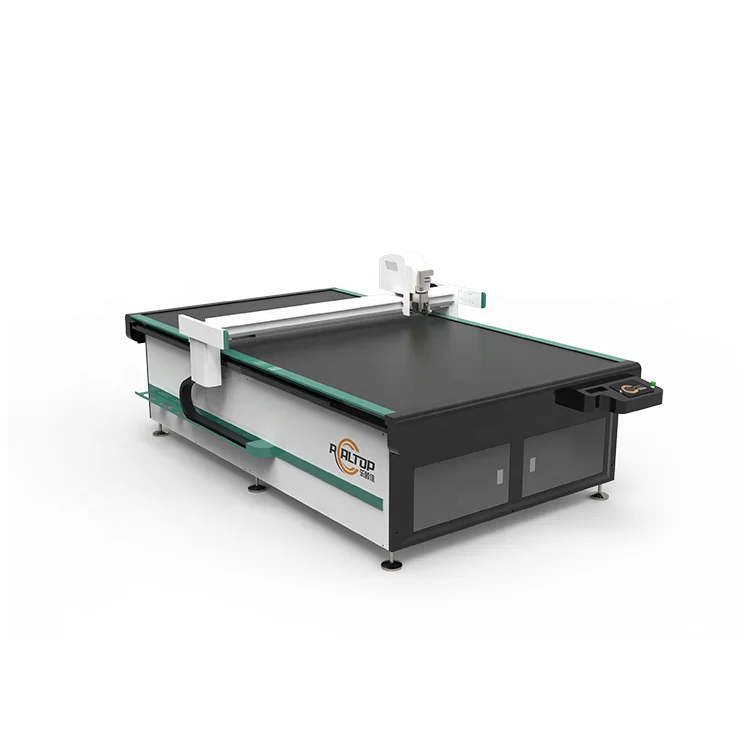
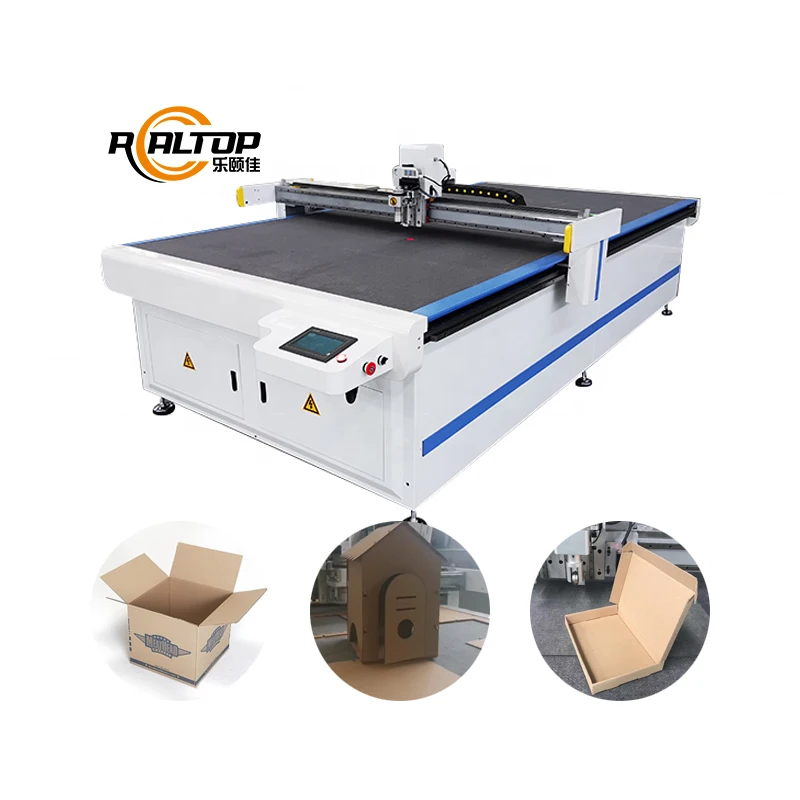
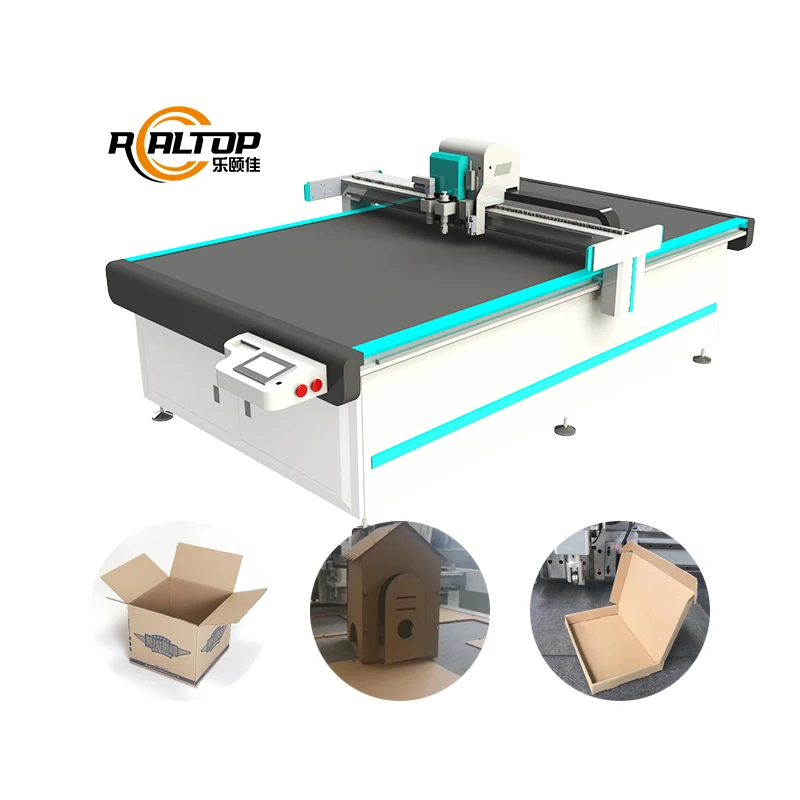
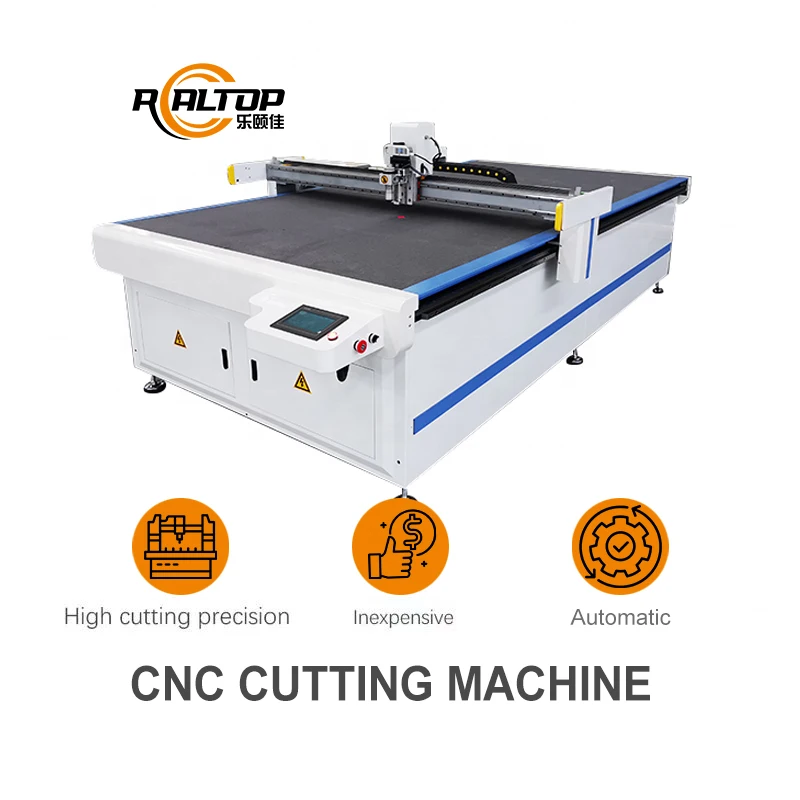
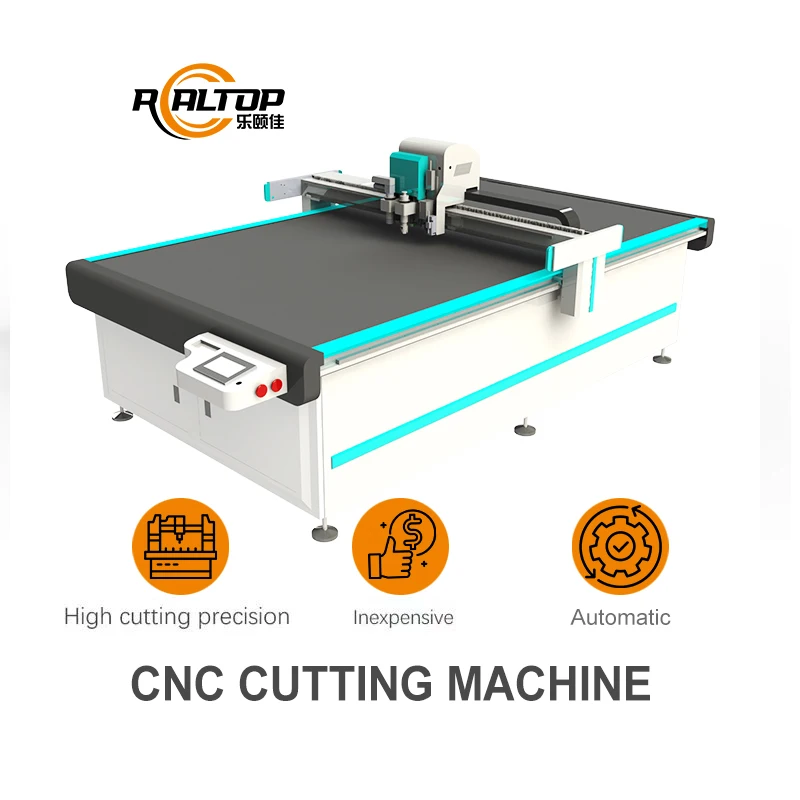


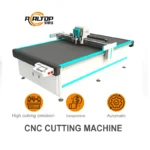


RT-D2516 CNC Flatbed Digital Cutting Table – OEM Available
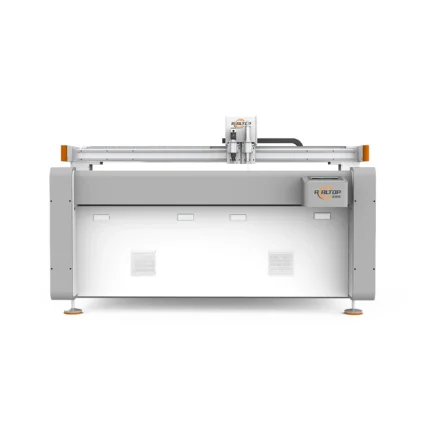
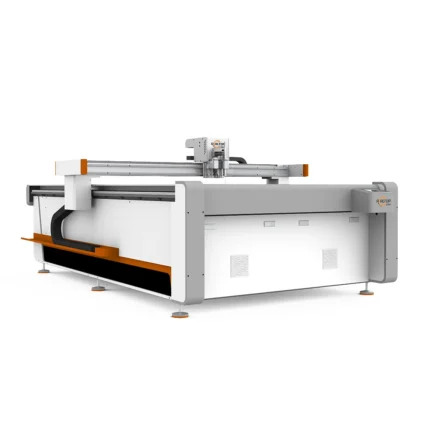
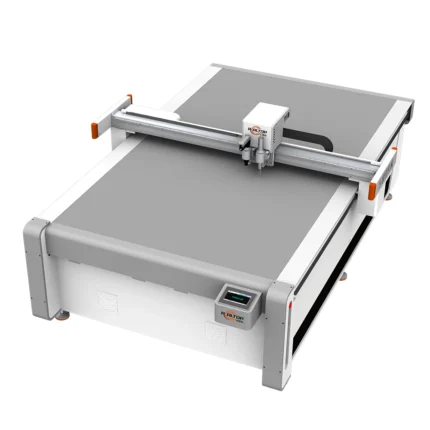
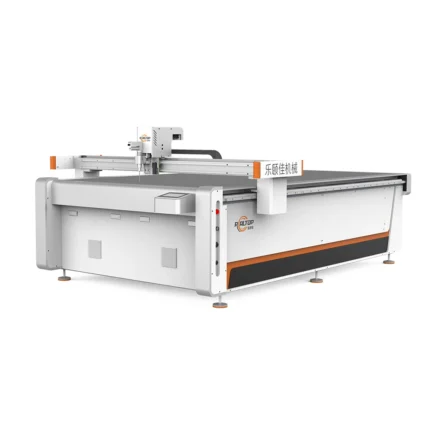
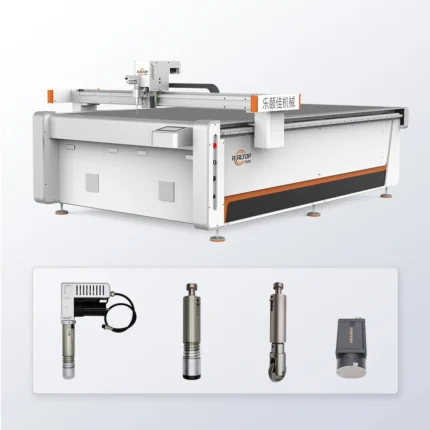
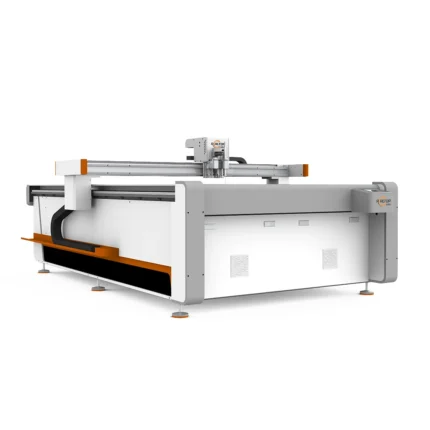
RT-D2516 CNC Flatbed Digital Cutting Table, 1600×2500 mm, 9 kW — configured for corrugated, cardboard and packaging sample production with Swiss imported oscillating knife, creasing wheel and cursor location functions.
- Japanese Yaskawa servo motors and Taiwan Hiwin linear rails deliver ≤0.1 mm repeatability
- 7.5 kW vacuum pump with German imported conveyor belt auto-feeding
- Pneumatic cutting tool option handles up to 70 mm dense board thickness
- HP-GL compatible instruction system for integration with existing design workflows
Tool head, vacuum zoning and voltage confirmed per your material before shipment, backed by sample cutting on buyer-supplied stock and full electrical schematic documentation.
Precision-Configured Tooling — the RT-D2516 flatbed cutting table pairs a Swiss oscillating knife with creasing and pneumatic options so corrugated and cardboard stock is cut and scored without crushed flutes.
Technical Specifications
| Parameter | Value |
|---|---|
| Model | RT-D2516 |
| Working Area | 1600 × 2500 mm |
| Overall Dimensions | 3450 × 2300 × 1250 mm |
| Rated Power | 9 kW |
| Table Type | Flat vacuum table with auto-feeding conveyor belt (German-sourced) |
| Multifunctional Head | Swiss-imported oscillating knife, vibration full-cut, half-cut, cursor location |
| Safety Device | Infrared sensors |
| Translational Velocity | 800 – 1200 mm/s |
| Repeated Accuracy | ≤ 0.1 mm |
| Transmission System | Digital servo motor, linear guide, synchronous belt, ball screw |
| Servo Motor | Japanese Yaskawa |
| Linear Rail | Taiwan Hiwin |
| Vacuum Pump | 7.5 kW |
| Instruction System | HP-GL compatible format |
| Voltage | 380 V ± 10 % |
| Cutting Thickness | Up to 70 mm (with pneumatic tool option; basis: dense corrugated/composite board) |
| Cutting Speed | 200 – 800 mm/s depending on material (basis not stated in source) |
| Additional Capabilities | Cutting, creasing, marking |
| Software / Manual | Manual, CD software, video; free training available |
| Warranty | 12 months whole machine, 3 months consumables |
Application Suitability
| Application | Material or Output |
|---|---|
| Carton and corrugated box sample making | Single-wall, double-wall and grey board up to 70 mm |
| Packaging prototyping | Corrugated flute profiles, honeycomb panels |
| Sticker and label contour cutting | Printed vinyl and adhesive stock |
| Gift box production | Chipboard, grey board, laminated card |
| Gasket and composite cutting | PVC, soft glass, silicone, rubber sheets |
| Leather and flexible garment cutting | Leather, sponge composite, fabric layers |
Why Voltage Verification Must Happen Before the Price Quote
Every RT-D2516 ships with a confirmed electrical schematic matched to the buyer’s facility supply, eliminating on-site transformer delays.
I once sent a machine to a customer overseas and assumed standard 380 V would work; the site actually ran on a different phase configuration. The unit sat idle for weeks while they sourced a step-down transformer, and the seasonal order window closed before production resumed. That failure reshaped how I handle every export order. Now, voltage, plug type and phase count are locked in writing before the CNC oscillating knife cutting table enters assembly. [NEED_CITE: voltage and frequency standards by export market]
Skipping this step costs far more than the price of a transformer — it costs delivery deadlines, customer confidence and sometimes the entire contract.
Matching the Tool Head to the Corrugated Flute Profile
The RT-D2516 is not sold as a single configuration. The Swiss-imported oscillating knife handles vibration full-cut and half-cut cycles, which is the standard setup for scoring and cutting corrugated packaging samples. When a buyer works with dense grey board or multi-layer composite panels, the pneumatic cutting tool option engages instead, reaching up to 70 mm of thickness without the edge compression that a standard blade would cause.
Tool head selection directly determines edge quality on flute profiles. A blade meant for thin card stock will crush the flutes of double-wall corrugated if the oscillation frequency is not adjusted, leaving the sample looking compressed rather than cleanly severed.
Vacuum Zoning and Small-Part Hold-Down
The 7.5 kW vacuum pump paired with the flat working table keeps corrugated sheets flat during high-speed cutting passes. On smaller sticker and label jobs, however, full-sheet vacuum is not always enough. Zoning the table surface so that only the active cutting zone draws suction prevents small cut pieces from lifting as the knife exits the contour.
The German-sourced conveyor belt feeding system adds continuous sheet handling, reducing the manual repositioning time between cuts. This combination is especially relevant for short-run packaging prototyping where dozens of different box dielines are cut in a single shift. [NEED_CITE: CE machinery directive requirements for vacuum hold-down on flatbed cutters]
Reading the Specs That Actually Matter
The ≤ 0.1 mm repeatability figure comes from the closed-loop feedback of the Japanese Yaskawa servo motors working against Taiwan Hiwin linear rails. On a 1600 × 2500 mm bed, even a slight drift accumulates into visible misalignment by the time the carriage reaches the far corner, so the rail and motor pairing is not a marketing line — it defines the positional tolerance your box dieline will hold across the entire sheet.
The translational velocity range of 800 – 1200 mm/s describes rapid traverse between cut points, not the cutting feed rate itself. Actual cutting speed varies with material density and thickness; the 200 – 800 mm/s range noted for this CNC oscillating knife cutting table reflects that variability across flexible materials and corrugated board.
HP-GL compatibility in the instruction system means most existing packaging CAD packages can output tool paths without a proprietary software purchase. If your design workflow already exports HP-GL or HP-GL/2, the learning curve is limited to nesting and tool assignment rather than retraining operators on a new interface.
The Cost of Specifying the Wrong Configuration
A flatbed cutting table purchased on working area alone — without confirming the tool head and vacuum zoning against your material — becomes a source of scrap rather than a production asset. Ragged edges on corrugated samples force manual trimming, and crushed flutes on display prototypes mean the sample never reaches the client’s approval desk. [NEED_CITE: common causes of edge damage on corrugated digital cutting]
When the vacuum hold-down is undersized for small parts, pieces lift during the final cut pass and the knife tears the contour rather than finishing it. These failures are not machine defects; they are configuration mismatches that could have been caught during the quoting stage with a sample cut report.
What You Get from a Manufacturer That Builds Both Knife and Laser Lines
The in-house design team covers both cutting technologies, so a buyer producing mixed-material packaging can evaluate whether a knife table or a laser cutter serves a given substrate better, rather than being steered toward one method regardless of fit.
Tool head and table configuration are specified per material type and production volume before the order is confirmed, not swapped after delivery. CCD camera positioning is available for printed contour work where sticker and label artwork must be cut along registration marks rather than absolute coordinates.
Software compatibility is checked against the buyer’s existing CAD format before production starts. Voltage, plug type and control language are confirmed in writing so that the machine arrives ready to power on. Sample cutting on the buyer’s own corrugated or cardboard stock is completed and reviewed before the unit ships. [NEED_CITE: manufacturer quality control documentation standards for CNC equipment]
Documentation & Verification
- Machine specification sheet with confirmed tool head and table configuration for your material
- Electrical schematic showing voltage, phase and plug type matched to your facility
- Sample cutting report on your corrugated or cardboard stock with edge quality photographs
- Software licence and HP-GL file format compatibility note for your existing design workflow
- Factory test record documenting positional accuracy across the full 1600 × 2500 mm bed
- Spare parts list covering blades, vacuum cups and conveyor belt segments
Installation, Commissioning & Support
- Floor space allocation for 3450 × 2300 mm footprint plus material staging clearance
- Dedicated 380 V ± 10 % circuit rated for the 9 kW total draw plus 7.5 kW vacuum pump
- Assembly and leveling of the flat vacuum table and German-sourced conveyor belt on site
- First-run parameter tuning of oscillation frequency and feed rate on your actual corrugated stock
- Operator training covering HP-GL file import, nesting, tool head changeover and safety infrared sensors
- Scheduled inspection intervals for Yaskawa servo motors, Hiwin linear rails and ball screw lubrication
Sending the Right Information with Your Inquiry
When you open a conversation about the RT-D2516, include the corrugated flute types and board thicknesses you run most often, the largest sheet dimension you need to cut, and the daily volume of samples or short-run production your shop handles. Confirm your facility voltage and phase supply so the electrical package is correct from the start.
Let us know which CAD or packaging design software you currently use so we can verify HP-GL file export and nesting workflow compatibility before the order is placed. If you want a sample cut report, ship a few sheets of your standard material and we will return cut and creased pieces along with the test documentation.
Frequently Asked Questions
Q: How do you verify cutting speed on my specific corrugated flute type?
A: We run a sample cutting test using your actual board stock and flute profile, recording the feed rate, oscillation frequency and edge quality. The results are documented in a cutting report so you can see the real speed and finish before the machine is built.
Q: What voltage and plug configuration is confirmed before shipment?
A: We confirm your facility’s voltage, phase count, frequency and plug type in writing during the quoting stage. The electrical schematic is included in the documentation package so your electrician can verify the supply before the machine arrives.
Q: Can the RT-D2516 import my existing CAD file format?
A: The instruction system supports HP-GL compatible format, which most packaging CAD packages export natively. We verify your specific software output against the controller before the order is finalized to ensure a direct workflow.
Q: Is CCD camera contour recognition available for printed packaging artwork?
A: Yes, CCD camera positioning is available as a configuration option for contour cutting along printed registration marks. This is confirmed during the tooling specification stage so the camera, software and lighting are matched to your print contrast.
Q: What does the warranty cover on this knife cutting table?
A: The warranty provides 12 months of coverage on the whole machine and 3 months on consumable items such as cutting blades and vacuum cups. The spare parts list in the documentation package identifies every replaceable component and its sourcing channel.


Related products
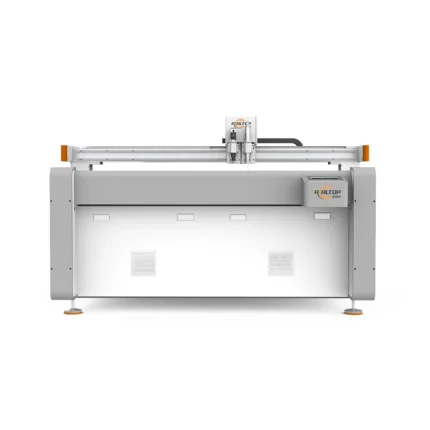
Automatic CNC Cutter Plotter 2026 Flat Bed Cardboard Cutter
Product Introduction
Automatic CNC Cutter Plotter 2026 is a flat bed cardboard cutting machine designed for precise and efficient cutting tasks. Ideal for various cardboard processing needs, it combines advanced CNC technology to deliver accurate results, suitable for manufacturing and packaging applications.Product Parameters
| Type | Automatic CNC Cutter Plotter |
| Model | 2026 |
| Design | Flat Bed |
| Application | Cardboard Cutting |
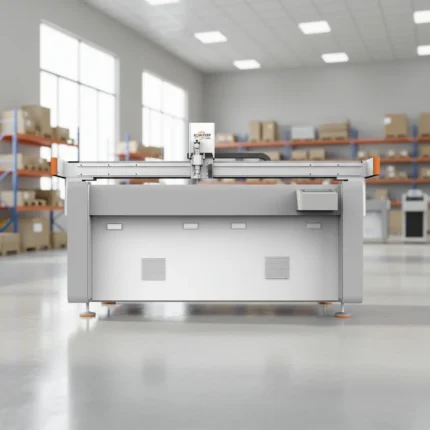
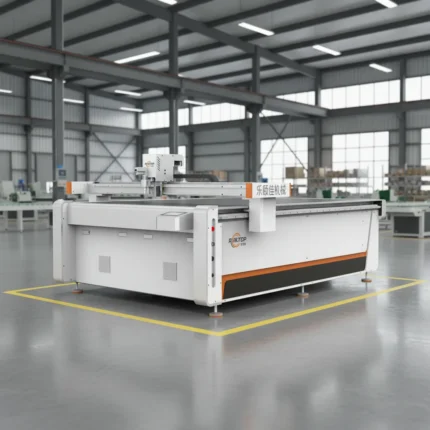
Automatic Die-less Cardboard Vibrating Knife Cutter 2026
Product Introduction
Automatic Die-less Cardboard Vibrating Knife Cutter 2026, a precision cutting solution for cardboard materials, featuring advanced die-less technology for efficient and flexible cutting operations. Ideal for various cardboard processing needs in manufacturing and packaging industries.Key Specifications
| Model | 2026 |
| Type | Automatic Die-less Cutter |
| Cutting Tool | Vibrating Knife |
| Material | Cardboard |

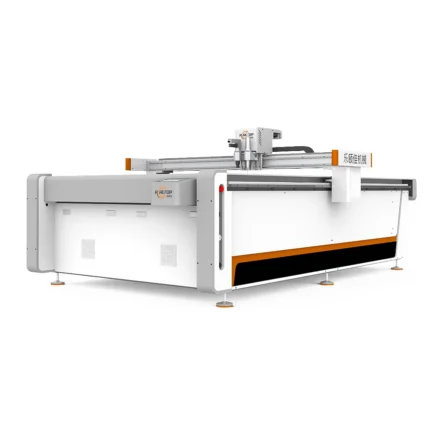
CNC Flatbed Oscillating Knife Cutting Machine 2026
Product Introduction
High-performance CNC Flatbed Oscillating Knife Cutting Machine 2026, ideal for precision cutting of various materials with advanced oscillating knife technology, ensuring efficient and accurate operations for industrial manufacturing needs.Specifications
| Model | 2026 |
| Type | CNC Flatbed Oscillating Knife Cutting Machine |
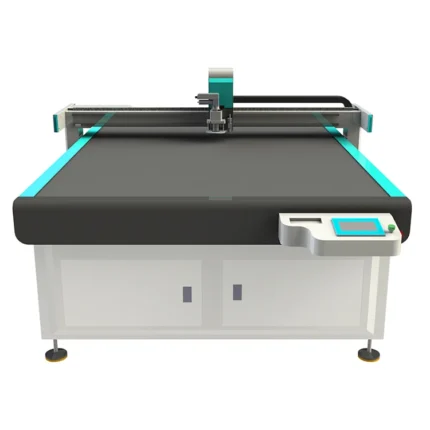
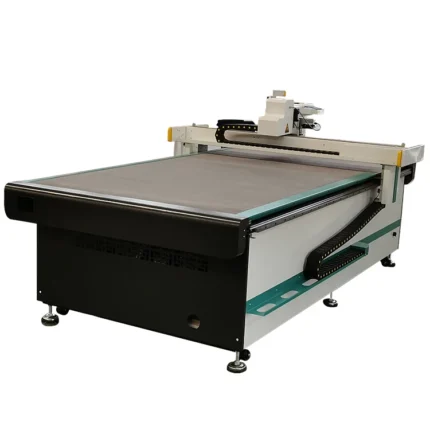
CNC Oscillating Knife Cutting Machine 2026 for Corrugated Cardboard & Honeycomb
Product Introduction
2026 CNC Oscillating Knife Cutting Machine, ideal for corrugated cardboard and honeycomb materials, offering precise and efficient cutting solutions for your production needs.Specifications
| Model | 2026 |
| Type | CNC Oscillating Knife Cutting Machine |
| Applicable Materials | Corrugated Cardboard, Honeycomb |
| Cutting Method | Oscillating Knife |
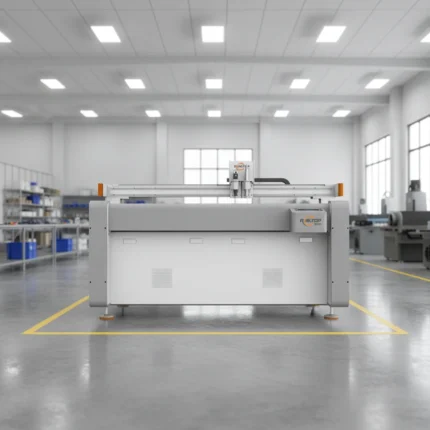
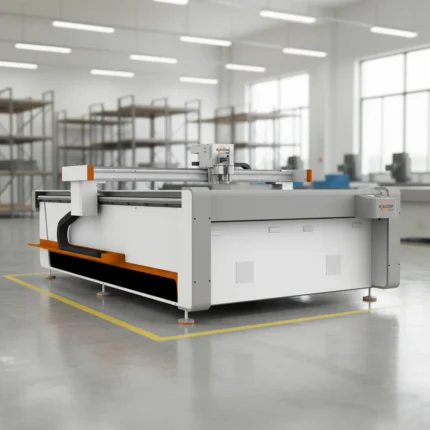

Realtop CNC Carton Box Cutter 2026 CCD Camera Honeycomb Cutting
Product Introduction
Realtop CNC Carton Box Cutter 2026 is a professional cutting solution featuring CCD Camera and Honeycomb Cutting technology, ideal for precise carton box processing with efficient performance.Product Parameters
| Model | Realtop CNC Carton Box Cutter 2026 |
| Vision System | CCD Camera |
| Cutting Technology | Honeycomb Cutting |
商品评价
There are no reviews yet.