

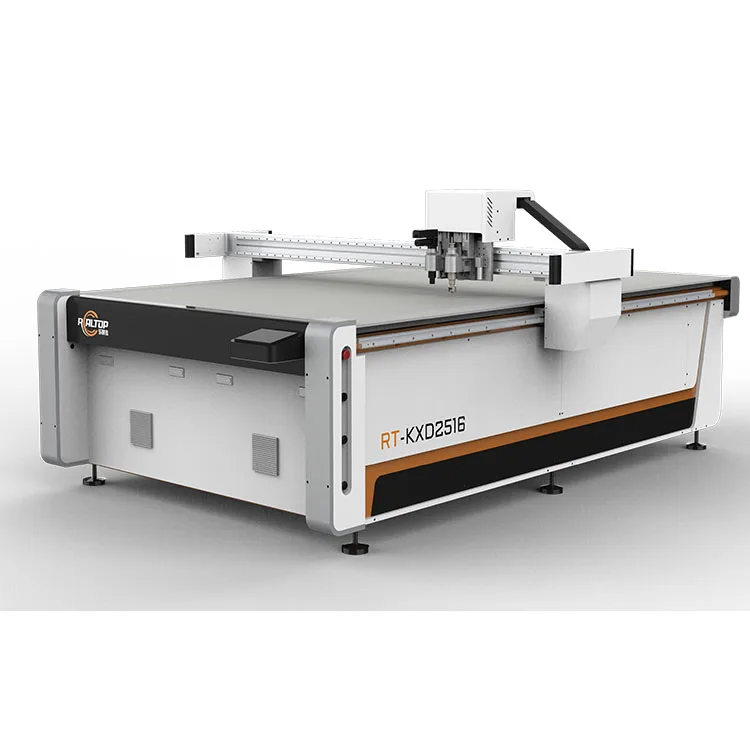
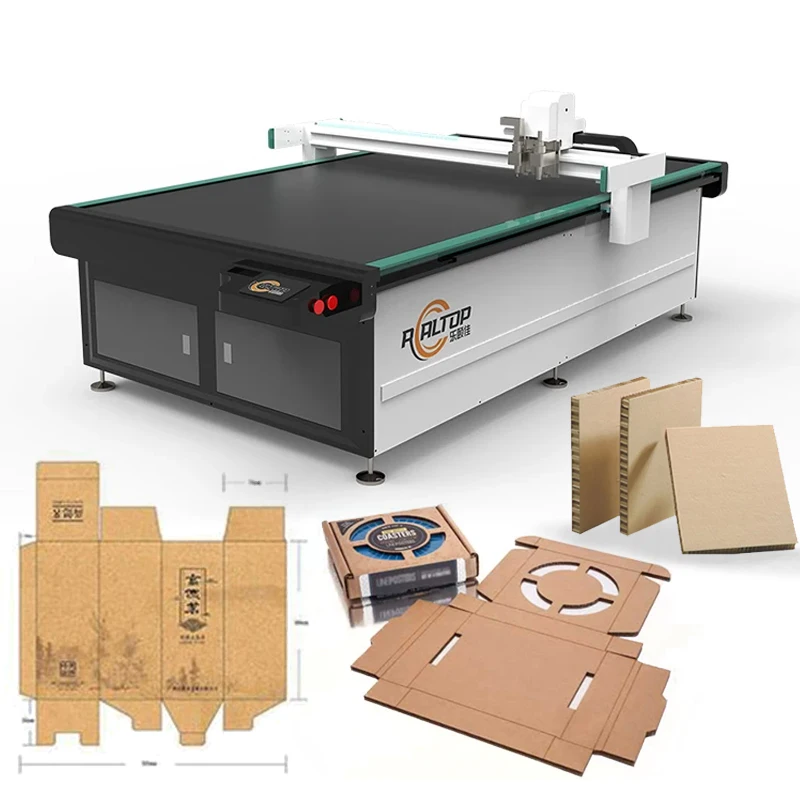
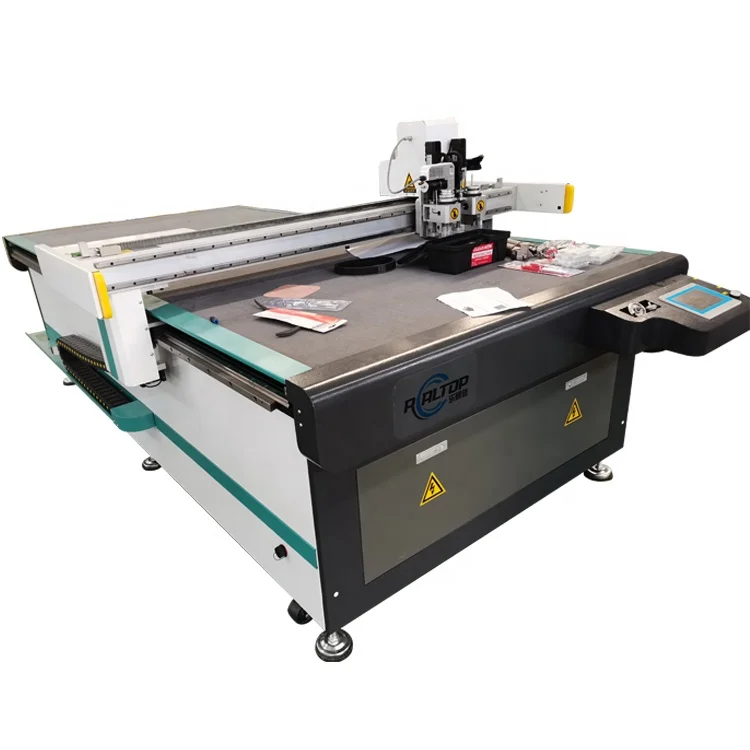
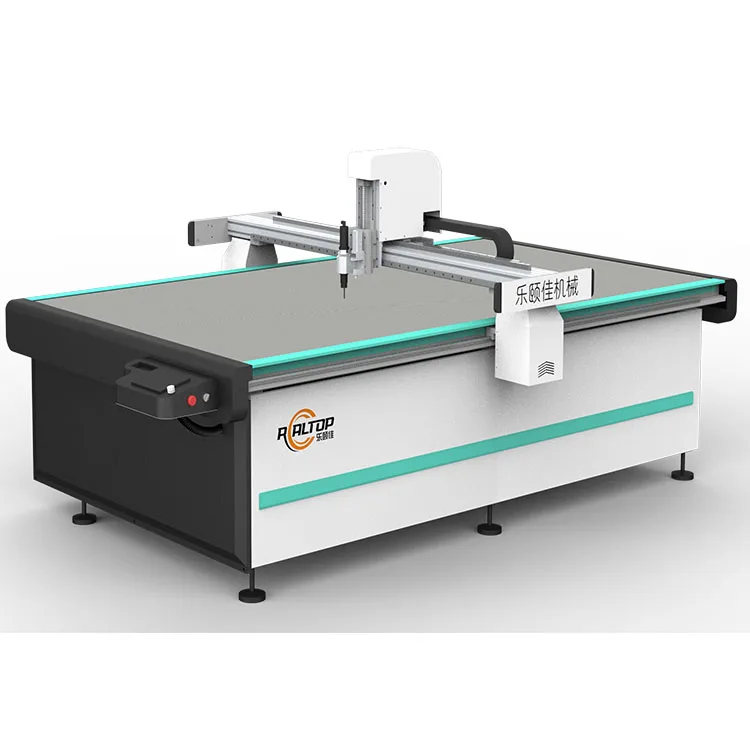
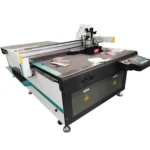
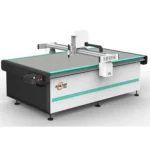
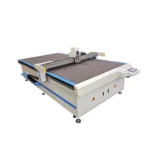
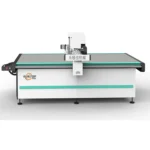


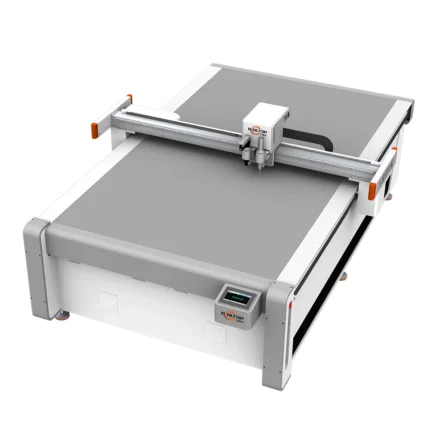
Cardboard CNC Cutter 1600x3200mm Auto Feeding Vision – Specifications
Sample cutting on your own material is conducted before commitment, with voltage, plug and control language confirmed prior to shipment.
Dual-Platform Engineering — Our oscillating knife tables and laser systems share the same motion control architecture, giving packaging converters a verified cutting method for each material rather than a forced compromise.
Technical Specifications
| Parameter | Value |
|---|---|
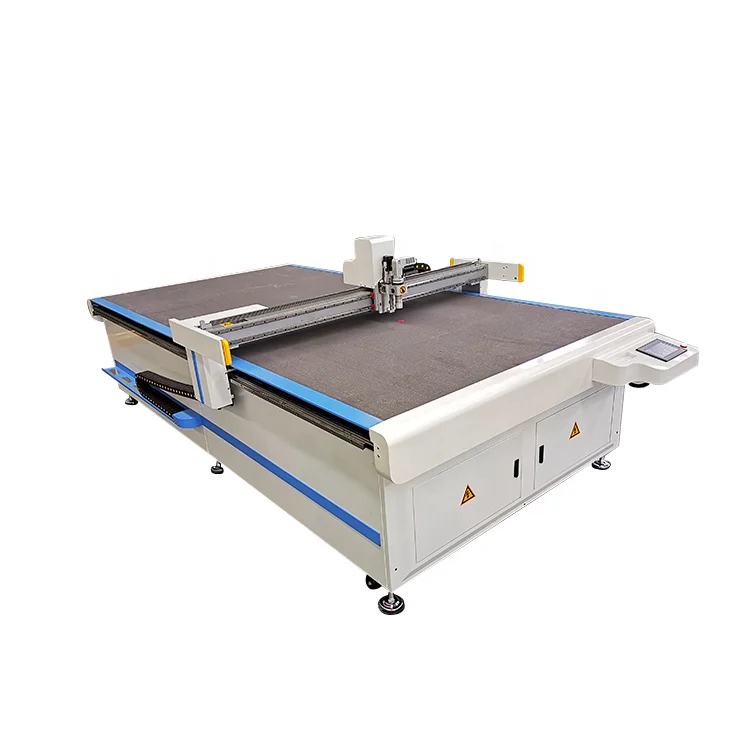
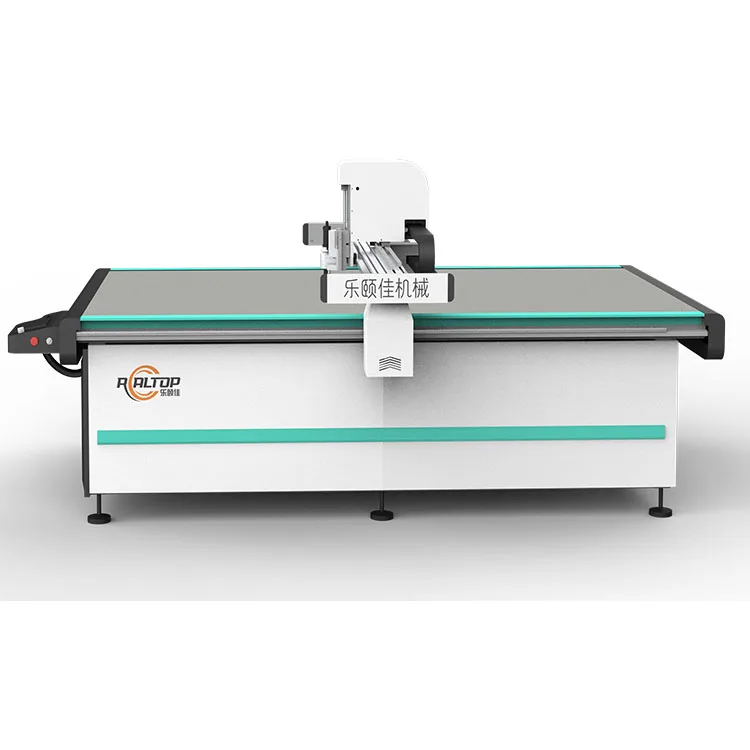
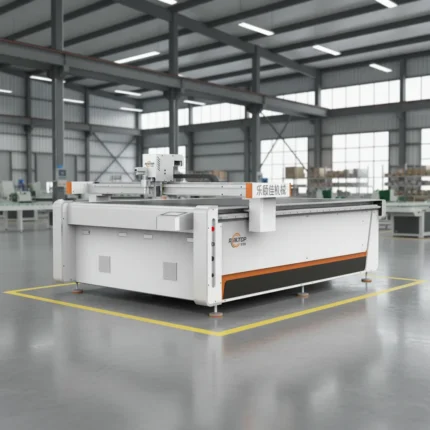
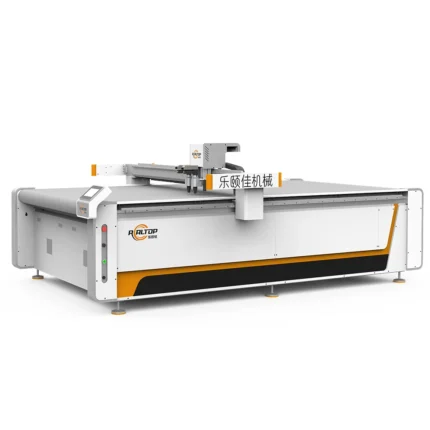
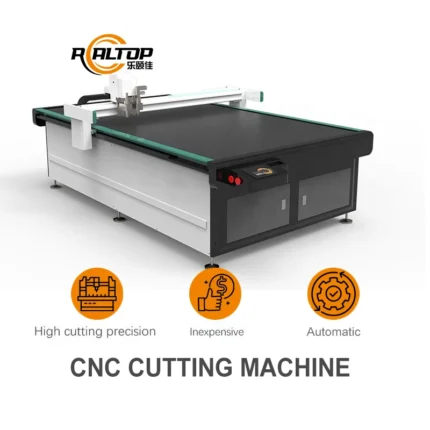
| Product Type | CNC Oscillating Knife Cutting Table |
| Working Area Options | 2500×1300mm (RT–R2513) / 1600×2500mm (RT-D2516 / RT-S2516) |
| Overall Dimensions | 3550×1910×1400mm (RT–R2513) / 3450×2300×1250mm (RT-D2516 / RT-S2516) |
| Rated Power | 9 kW |
| Voltage | 380V |
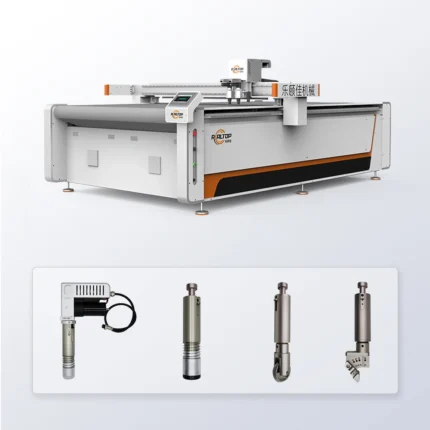
| Cutting Tools | Oscillating knife, Creasing tool, Kiss-Cut Knife, Round punch |
| Maximum Cutting Thickness | ≤18mm |
| Fixing Method | Vacuum system with aluminum alloy honeycomb platform |
| Vacuum Pump | 7.5 kW |
| Repeated Accuracy | <0.05mm |
| Servo Motor | Dongling or Delta servo motor (configurable) |
| Guide Rail | Taiwan Hiwin rail |
| Auto Feeding | Yes, with imported conveyor belt |
| Profile Format | DXF, OLT, PDF, AI |
| Safety Device | Infrared sensors, emergency stop |
| Software | Professional carton nesting software with customizable language |
| Language Options | English, Russian, Italian, Chinese (customizable) |
Application Suitability
| Application | Material or Output |
|---|---|
| Corrugated packaging sample making | Single, double, and triple-wall corrugated board up to 18mm |
| Sticker and label contour cutting | Adhesive-backed vinyl, PP paper, and printed label stock |
| Gift box and paper box production | Solid cardboard, greyboard, and coated paper stocks |
| Express paper box packaging | Lightweight corrugated and honeycomb paper board |
| Large electrical carton packaging | Heavy-duty corrugated board requiring deep crease lines |
| Short-run folding carton | Artboard and SBS board without die tooling investment |
Why Burnt Edges Force Packaging Converters Toward Knife Cutting
Oscillating knife technology eliminates the charring and fume extraction problems that CO2 laser systems create on cellulose-based packaging materials.
When a packaging buyer evaluates a CNC laser cutting and engraving machine manufacturer, the conversation often starts with laser wattage and bed size. But cardboard, corrugated board, and adhesive sticker stock respond poorly to thermal cutting. The laser beam carbonizes the flute tips on corrugated material, leaves brown scorch marks on white-coated carton, and melts the adhesive layer on sticker sheets, causing residue buildup on the lens and extraction filters [NEED_CITE: thermal degradation of cellulose fibers under CO2 laser exposure]. For these materials, the cutting method must match the substrate chemistry, and that is where a precision oscillating knife table fills the gap that laser alone cannot close.
Clean Edges Without Thermal Damage
Cardboard and corrugated packaging demand cut edges that remain visually clean for retail presentation and structurally intact for folding. The oscillating knife on the RT–R2513 and RT-D2516 slices through flute structures without generating heat, preserving the natural color of kraft liner and white top-sheet alike. This matters when a packaging converter runs short-run samples for brand approvals, where scorched edges would be rejected at the proofing stage. A CNC laser cutting and engraving machine manufacturer that also builds knife tables can recommend the correct process without bias toward one technology.
Creasing and Cutting in a Single Setup
The creasing tool head on this platform presses a rounded wheel into the board to form fold lines without cutting through the material. Combined with the oscillating knife for outline cutting and the round punch for handle holes or ventilation slots, a carton sample maker completes the entire box blank in one fixturing cycle. The vacuum adsorption platform holds the sheet flat while the tool changer swaps heads under software control, eliminating the manual re-fixturing that causes registration errors between crease and cut lines [NEED_CITE: registration tolerance requirements in folding carton sample making].
How Key Specifications Translate to Production Reality
The 7.5 kW vacuum pump paired with the aluminum honeycomb table generates sufficient hold-down force across the full 1600×2500mm bed of the RT-S2516, but zoning configuration determines whether small nested parts remain flat during cutting. A board that lifts at the edge produces dimensional inaccuracy and blade deflection. The <0.05mm repeated accuracy specification depends on the Taiwan Hiwin linear rails and servo drive maintaining positional consistency across long traverse paths. The 9 kW rated power covers the spindle motor, vacuum pump draw, servo drives, and conveyor feed system simultaneously without voltage sag. The imported conveyor belt on the auto-feeding variant advances the material roll forward after each cut cycle, enabling continuous nesting from roll stock without operator intervention between sheets.
The Cost of Wrong Tool Head Selection
A buyer who specifies an oscillating knife for dense composite gasket material or a drag knife for thick corrugated board will encounter ragged edges, excessive blade wear, and crushed flute profiles. The wrong vacuum zoning leaves small sticker labels lifting off the table mid-cut, destroying registration and generating scrap. Software that cannot import the buyer’s DXF or AI files forces manual redraw, adding hours to each new job setup. These problems surface only after the machine arrives and production begins [NEED_CITE: post-installation tooling mismatch in digital flatbed cutting operations].
Why Source Both Knife and Laser From One Manufacturer
Our factory designs and builds both oscillating knife tables and CO2 laser systems on shared motion platforms, meaning the linear rails, servo drives, and control architecture are proven across product lines. This gives a packaging converter a single supplier for carton sample cutting and acrylic signage engraving without managing separate support channels. We configure tool heads and vacuum zoning based on the buyer’s actual material stack rather than a generic catalog sheet. Software file format compatibility is confirmed during the quotation stage, not discovered at commissioning. Voltage, plug type, and interface language are locked in before production begins. Sample cutting on the buyer’s own board stock is completed and documented before the order ships.
Documentation & Verification
- Factory test record cut on buyer-supplied corrugated board at specified thickness
- Electrical schematic confirming 380V wiring and 7.5 kW vacuum pump circuit
- Tool head configuration list matching oscillating knife, creasing wheel, and punch to material
- Software license and DXF/OLT/PDF/AI file format compatibility verification note
- Professional carton nesting software with customized language confirmed before dispatch
- Spare parts list including ten oscillating blades and vacuum pump filter elements
Installation, Commissioning & Support
- 3450×2300mm footprint of the RT-D2516 requires level concrete floor with clearance for conveyor infeed and outfeed
- 380V three-phase dedicated circuit rated above 9 kW continuous draw with proper earth bonding
- Machine ships partially assembled; vacuum platform and gantry require on-site alignment and rail calibration
- First-run commissioning includes vacuum zoning test on buyer’s smallest nested part geometry
- Operator training covers tool head changeover, creasing wheel pressure adjustment, and nesting software workflow
- Ten oscillating blades included; replacement blade sourcing and felt pad renewal covered under spare parts list
What We Need to Quote Accurately
Send us the specific board type, flute profile, and maximum thickness you run most often, along with typical sheet dimensions and whether you process from roll or sheet stock. Tell us your local voltage and frequency standard, the interface language your operators need, and which file formats your design team currently outputs. If you have existing creasing wheel profiles or punch diameters in use, share those specifications so we can match tooling from the start.
Frequently Asked Questions
Q: How does oscillating knife cutting compare to CO2 laser for cardboard and packaging materials?
A: Oscillating knife produces clean, unburnt edges on corrugated board and cardboard, avoiding the charring and fume extraction issues that CO2 laser creates on cellulose-based substrates. For packaging sample making and short-run carton production where edge appearance and adhesive integrity matter, knife cutting is the standard process. Laser remains preferable for acrylic, wood, and engraved signage applications.
Q: What is the real cutting thickness on corrugated board versus solid cardboard?
A: The platform handles materials up to 18mm thick, but actual performance depends on board density and flute structure. Triple-wall corrugated cuts cleanly at thicknesses where solid greyboard would require multiple passes or excessive blade pressure. We test your specific material and provide a sample cutting report confirming edge quality and achievable thickness before you commit to an order.
Q: Can this machine handle printed contour cutting with CCD camera positioning?
A: The platform supports CCD camera contour recognition as a configuration option, tracking printed registration marks to align cut paths with pre-printed graphics. This is essential for sticker and label producers cutting around printed artwork. We verify mark detection reliability at your intended production speed during the sample cutting stage before shipment.
Q: How do I verify edge quality and crease depth on my specific material before ordering?
A: Send us representative samples of the board, cardboard, or sticker stock you process most frequently. We run cutting and creasing tests on our factory floor, document edge quality, crease depth, and tool head configuration in a sample cutting report, and share the results with you for approval before production begins.
Q: What voltage and language customization is available before shipment?
A: The standard configuration runs on 380V three-phase power, but voltage can be confirmed and adjusted to match your local supply standard. The control interface and nesting software language are customizable across English, Russian, Italian, Chinese, and other options. We lock these specifications during the quotation stage to avoid on-site compatibility issues.


Related products
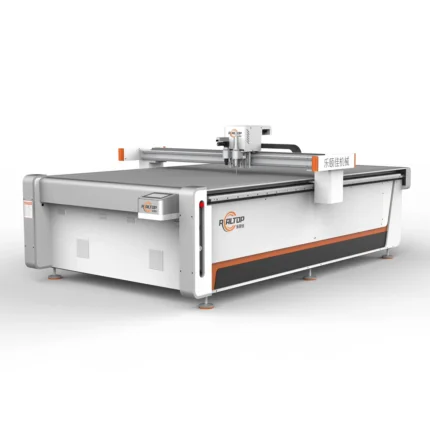
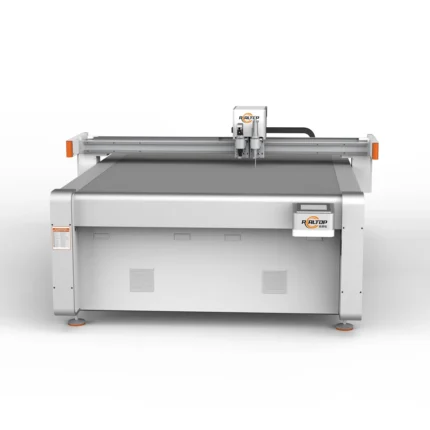
Automatic Digital Cardstock Cutter 2026 CNC Cutter
Product Introduction
Automatic Digital Cardstock Cutter 2026 is a CNC cutting machine ideal for white cardboard and kraft paper. It offers precise and efficient cutting performance, suitable for various paper processing needs in manufacturing and craft applications.Key Specifications
| Type | CNC Digital Cutting Machine |
| Material Compatibility | White Cardboard, Kraft Paper |
| Operation | Automatic |
| Application | Paper Cutting & Processing |
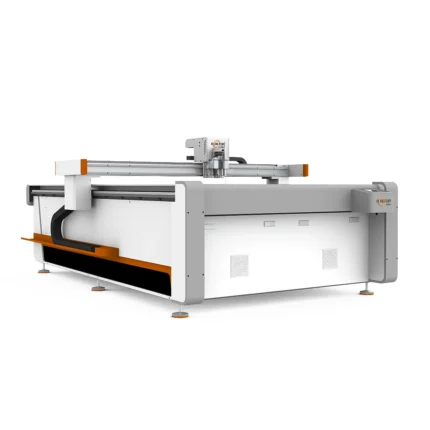
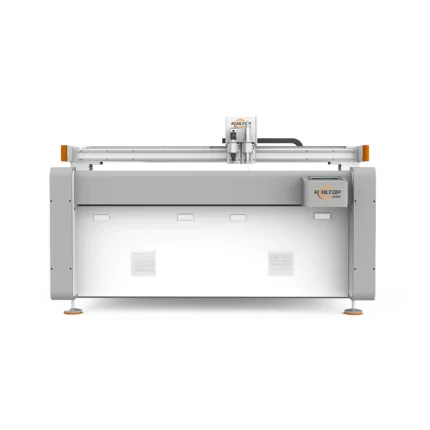
CNC Flatbed Cutter 2026 Digital Corrugated Box Making Machine
Product Introduction
High-precision CNC flatbed cutter designed for efficient cardboard box production. Ideal for 2026 digital corrugated box manufacturing, offering precise cutting and reliable performance for professional packaging solutions.
Key Specifications
| Type | CNC Flatbed Cutter |
| Application | Cardboard Box Production |
| Technology | 2026 Digital System |
| Material | Corrugated Board |

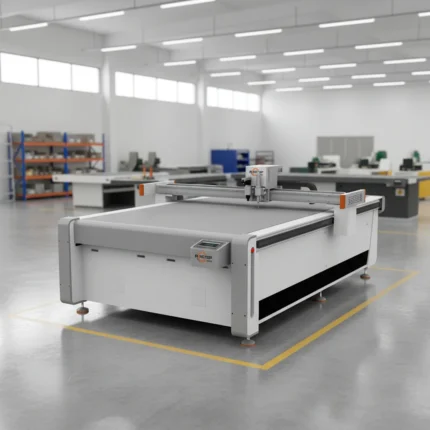
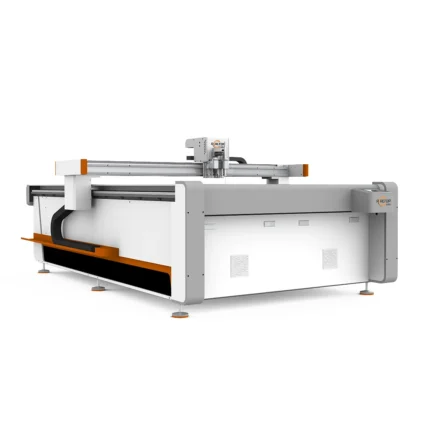
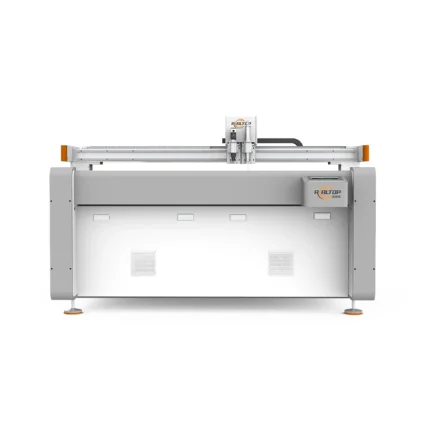
Digital Box Cutter 2026 Oscillating Knife Cardboard Cutter
Product Parameters
| Model | Digital Box Cutter 2026 |
| Cutting Type | Oscillating Knife |
| Material | Corrugated Cardboard |
Introduction
Professional oscillating knife cutting machine for corrugated cardboard. Ideal for precise, efficient cutting in packaging production. Reliable performance from China's leading welding & cutting equipment manufacturer.
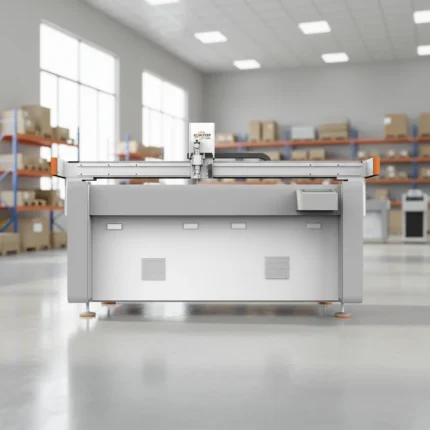

Realtop 2026 CNC Oscillating V-Cut Machine
Product Introduction
Realtop CNC Oscillating V-Cut Machine 2026 is a precision equipment designed for efficient V-cutting operations, ideal for various material processing needs with advanced CNC technology.
Key Specifications
| Model | Realtop CNC Oscillating V-Cut Machine 2026 |
| Type | CNC Oscillating V-Cut Machine |
| Application | Precision V-cutting operations |
| Feature | Advanced CNC technology |

REALTOP 2026 Digital Industrial Cardboard Box Cutter
Product Introduction
REALTOP Digital Industrial Cardboard Box Cutter Machine 2026 is a professional industrial-grade cutting equipment designed for efficient cardboard box processing, ideal for manufacturing and packaging applications.
Product Parameters
| Model | 2026 |
| Type | Digital Industrial Cardboard Box Cutter |
| Application | Cardboard Box Processing |
| Feature | Industrial-grade, Efficient Cutting |
商品评价
There are no reviews yet.