

Blog
Can a CNC machine cut cardboard?

Can a CNC machine cut cardboard?
If you run a packaging shop or print small batches of custom boxes, you have probably looked at your die-cutting press or hand-cutting station and wondered whether there is a faster way to handle those 50-piece prototype runs. CNC knife cutting sounds promising, but you worry it might burn edges like a laser or crush flutes like a badly adjusted press.
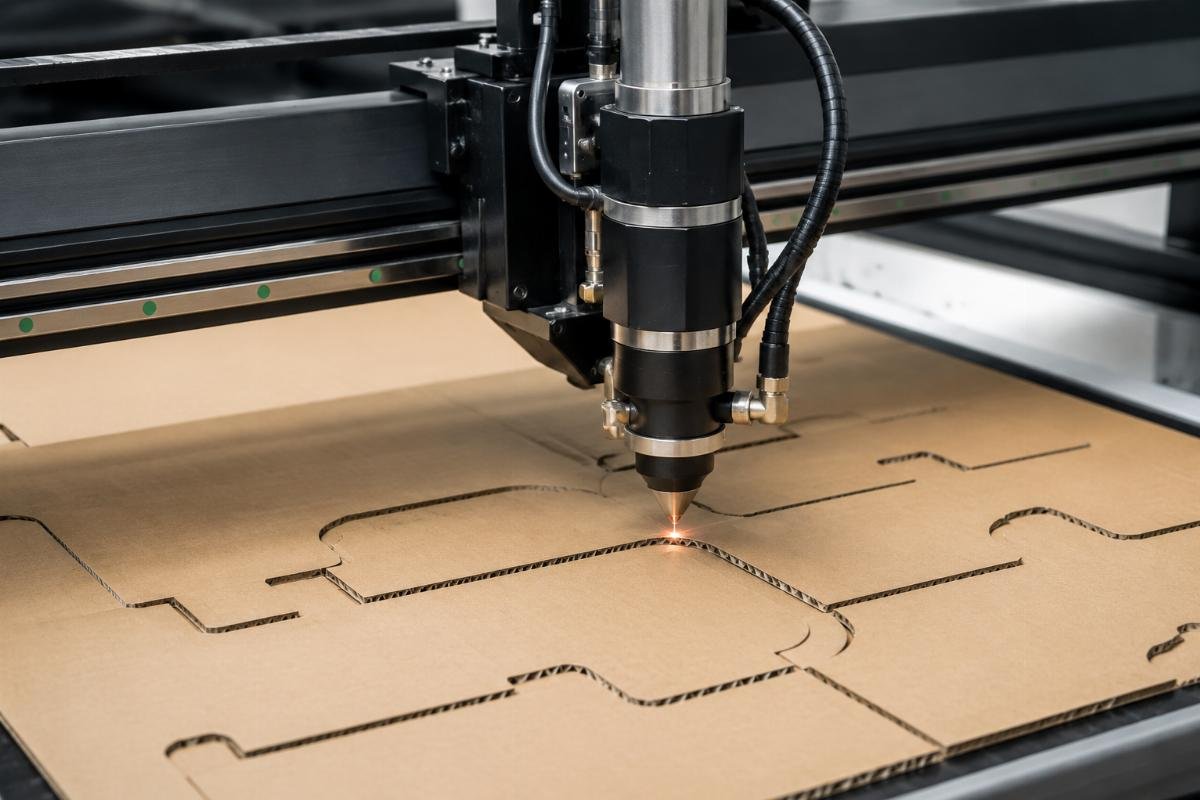
Yes, CNC knife cutting machines can cut cardboard—specifically corrugated sheets from 2 to 8 mm thick and paperboard from 200 to 1200 gsm1—using an oscillating blade instead of a laser or press die, which means no burning, no crushing, and no upfront tooling cost for each new design.
I have stood beside customers during on-site tests at our Jinan factory, watching them run their own cardboard samples through our RT-CKD series machines. The question they always ask first is not whether the machine can cut, but whether it can hold tolerances when they switch from one box design to another five times in a single afternoon without ordering new dies.
How does CNC knife cutting work on cardboard?
Most people assume CNC cutting means either laser or waterjet, which explains why the first worry is always about burned edges or soggy paper. CNC knife cutting uses neither heat nor liquid.
A CNC knife cutter employs a fast-oscillating blade mounted on a three-axis gantry, driven by servo motors that follow vector paths from your CAD file, while a vacuum table holds the cardboard flat—no flame, no water, and no mechanical press plate that might flatten corrugated flutes.
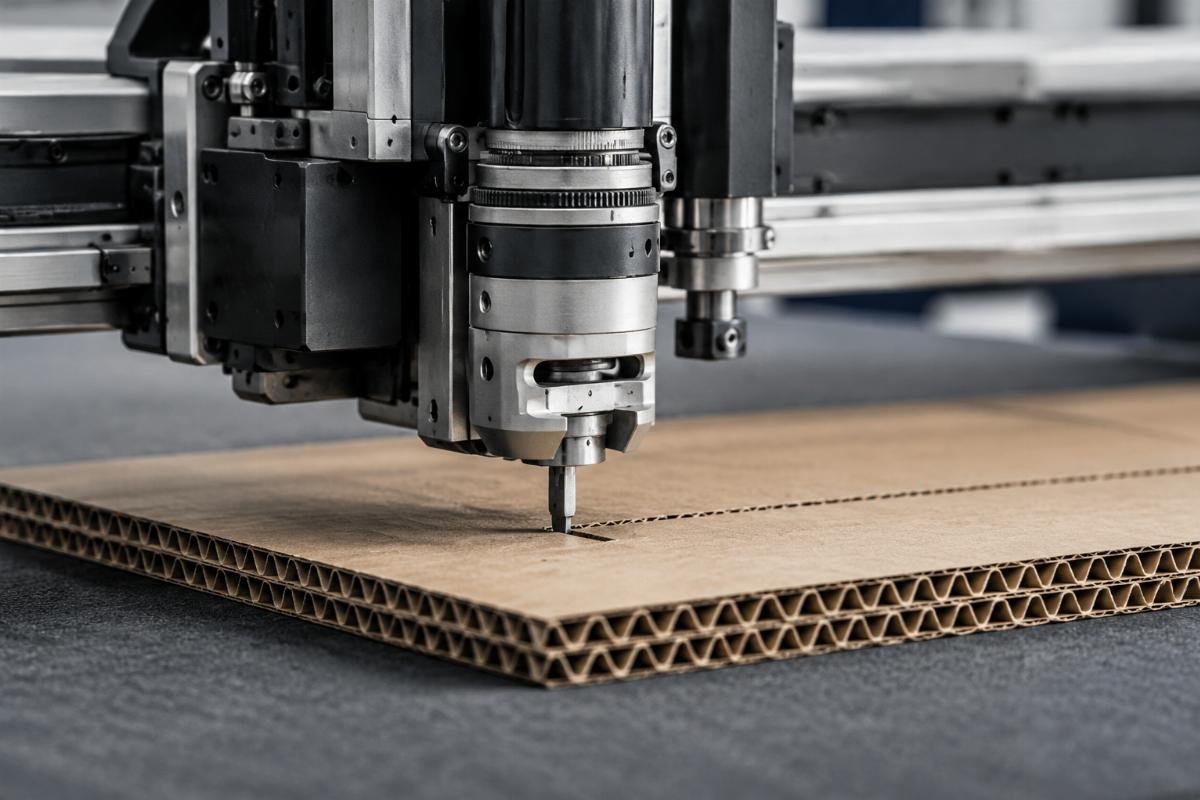
The blade vibrates at high frequency—typically 5,000 to 8,000 strokes per minute2—while the gantry moves it along the cut path at speeds ranging from 100 to 1,200 millimeters per second depending on material density. Below the cardboard sits a vacuum table with multiple zones, so you can turn suction on only where the sheet rests, preventing flutter during cutting. We configure blade depth by measuring material thickness with a digital probe before each job, then set the blade tip to penetrate just 0.3 millimeters into the cutting mat below the cardboard, which means the blade cuts through without damaging the mat or leaving ragged bottom edges.
What types of cardboard can a CNC machine handle?
Not all cardboard behaves the same under a blade. I have seen customers bring in everything from thin chipboard jewelry boxes to heavy-duty shipping cartons, and each material requires different blade angles and speeds.
| Material type | Thickness range | Typical application | Blade configuration |
|---|---|---|---|
| Single-wall corrugated | 2–4 mm | E-commerce mailer boxes, light packaging | 45° oscillating blade, 800 mm/s feed rate |
| Double-wall corrugated | 5–8 mm | Industrial shipping boxes, protective inserts | 52° heavy-duty blade, 400 mm/s feed rate |
| Solid paperboard (chipboard) | 200–1200 gsm | Folding cartons, cosmetic boxes, retail packaging | 30° precision blade, 1,000 mm/s feed rate |
| Honeycomb cardboard panel | 10–30 mm | Furniture inner structure, eco-friendly pallets | Drag knife or 60° blade, 200 mm/s feed rate |
| Laminated cardboard (coated or foil-backed) | 1–5 mm | Premium gift boxes, food packaging | 45° blade with ceramic coating, 600 mm/s feed rate |
Single-wall corrugated, the most common type, consists of one layer of wavy fluting glued between two flat liners3. CNC cuts it cleanly as long as you run the blade perpendicular to the flute direction at corner curves—cutting parallel to flutes can cause tearing because the blade follows the air gaps instead of slicing fibers. Double-wall corrugated adds a second flute layer, which doubles the crush resistance but also means the blade must penetrate deeper and move slower to avoid pushing the material instead of cutting it. Solid paperboard has no flutes, so it cuts faster and holds tighter tolerances, which is why we see many cosmetic and pharmaceutical packaging customers choose CNC for chipboard prototypes. Honeycomb panels, made from expanded paper cells, require a drag knife or a blade with a steep angle because the open structure can collapse if the blade oscillates too fast. Laminated materials with plastic or foil coatings demand ceramic-coated blades to prevent edge buildup that dulls the blade after a few hundred cuts.
When does CNC cutting beat die-cutting for cardboard?
Die-cutting dominates high-volume packaging production because the per-unit cost drops to pennies once you spread the die tooling expense across tens of thousands of pieces. CNC cannot match that speed for identical repeating cuts.
CNC knife cutting becomes cost-effective when your order batch size stays below 500 pieces or when you need to produce multiple different designs in a single production day, because you eliminate die tooling costs—which typically run from 200 to 2,000 USD per design depending on complexity4—and reduce setup time from hours to minutes.
I worked with a customer in Germany who produces custom packaging for craft breweries. Each brewery orders between 50 and 200 boxes with unique graphics and dimensions. Before switching to CNC, they paid for a new die every time a brewery changed its logo or box size, and the die cost often exceeded the profit from the entire order. After deploying our RT-CKD series machine, they load a new DXF file, adjust the blade depth, and start cutting within ten minutes. Their break-even point moved from 800 pieces down to about 60 pieces per design, which opened up a customer segment they could not serve profitably before.
The math changes when you cut the same design repeatedly for months. If you run 10,000 identical boxes, die-cutting cuts each one in two seconds, while CNC takes 30 seconds5 because it follows every vector with a moving blade. The die costs 800 USD, so the crossover happens around 800 pieces when CNC setup time savings no longer offset the per-piece speed advantage of die-cutting. Below that volume, CNC wins; above it, die-cutting wins unless you value design iteration speed more than pure throughput.
What cutting quality should I expect from CNC on cardboard?
I have watched customers inspect cut edges with magnifying glasses during factory tests because they worry about frayed fibers or dimensional drift when stacking multiple sheets. Quality depends on three variables you control during setup.
CNC knife cutting on cardboard delivers clean edges with dimensional accuracy within ±0.5 millimeters6 when you configure blade depth to match material thickness, tune feed rate to prevent material pushing, and ensure the vacuum table holds the sheet flat—results I have seen confirmed in customer pilot runs using calibrated samples.
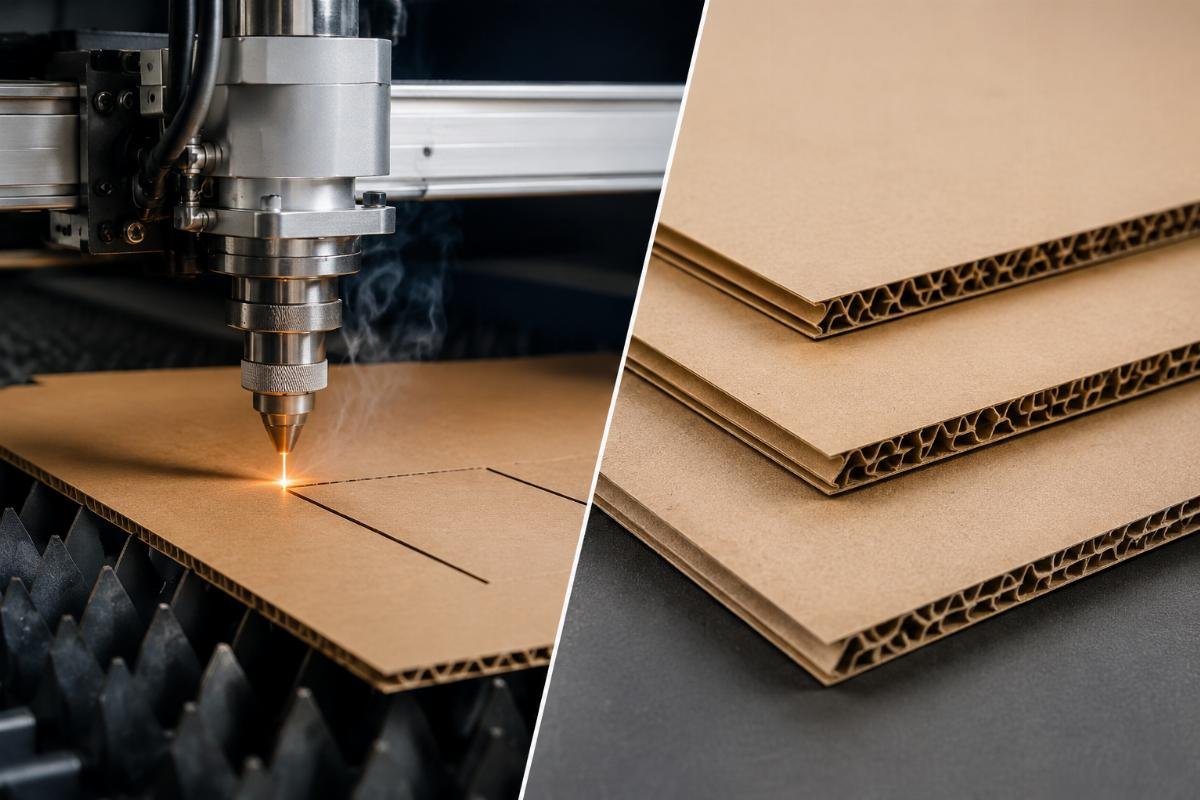
Blade depth matters most. Set it too shallow and the blade leaves uncut fibers at the bottom; set it too deep and it drags through the cutting mat, dulling the tip and creating a ridge on the underside of the cardboard. We measure material thickness at three points across the sheet because corrugated board can vary by half a millimeter from one edge to the other, then set blade penetration to 0.2 millimeters below the thinnest reading. Feed rate controls how fast the blade travels along the cut line. If you push chipboard faster than 1,200 millimeters per second, the blade starts shoving the material instead of slicing it, which causes the edge to compress and buckle. For corrugated, slower speeds around 600 millimeters per second work better because the blade has time to cut through each flute cleanly without tearing the liner. Vacuum hold-down prevents the sheet from lifting during cutting, which would tilt the blade angle and create beveled edges. We divide the table into zones and activate only the sections under the cardboard, applying about 60 percent of maximum suction7—too much suction can actually deform thin chipboard by pulling it into the vacuum holes.
Corner radius affects quality too. Sharp 90-degree corners require the blade to decelerate, pivot, and accelerate again, which can leave a small overcut or undercut depending on tuning. We typically program a 1-millimeter radius on internal corners for corrugated and a 0.5-millimeter radius for chipboard, which keeps the blade moving smoothly without asking the servo motors to stop instantly.
What setup costs and lead times should I expect?
One customer from Texas told me his biggest frustration with die-cutting was not the cost but the two-week wait every time he needed to tweak a box dimension. CNC eliminates that delay.
CNC knife cutting requires no physical tooling for each new design—you export a DXF or AI file from your CAD software, load it into the machine control software, and start cutting within five to ten minutes—compared to die-cutting, which requires ordering a steel-rule die that takes 7 to 14 days to fabricate8 and costs between 200 and 2,000 USD depending on size and complexity.
The machine itself costs more upfront. A basic CNC knife cutter for cardboard starts around 25,000 USD for a 1300×2500 mm working area9, while a manual die-cutting press costs about 8,000 USD. But the press needs a die for every design, and if you produce 20 different box styles per year, you spend 4,000 to 40,000 USD on dies alone. CNC pays back within six to eighteen months depending on how many designs you run and how often they change10.
Lead time compression matters more than cost for some customers. I worked with an advertising agency in Shanghai that produces point-of-sale displays for retail chains. They receive approved artwork on Monday and need finished displays in stores by Friday. Die lead time alone would consume half that window. With CNC, they cut prototypes Tuesday morning, get client approval Tuesday afternoon, and run the full batch Wednesday and Thursday, leaving a day for assembly and delivery.
Can CNC cut multiple sheets at once?
Speed-conscious customers always ask whether they can stack ten sheets and cut them all in one pass, the way a die press does. CNC works differently.
CNC knife cutters cut one sheet at a time because the blade penetrates only 0.3 millimeters below the bottom surface—stacking multiple sheets would require deeper penetration, which causes excessive friction, blade wear, and bottom-layer tear-out—though you can load multiple single sheets side by side on the table and cut them in sequence without operator intervention.
Some shops try stacking anyway, especially with thin chipboard, and it works up to a point. Two sheets of 300-gsm paperboard can cut together if you increase blade depth and slow the feed rate by 40 percent, but edge quality on the bottom sheet degrades because the blade drags through compressed layers instead of slicing cleanly. We do not recommend stacking for production work, but it can speed up sampling when you need five identical prototypes quickly.
The practical throughput method involves tiling multiple different designs on the table at once. A 1300×2500 mm table holds twelve 400×600 mm box blanks, and the machine cuts all twelve in a single unattended cycle lasting about 25 minutes. An operator loads the table, starts the cycle, and returns when the machine signals completion, which means one person can supervise two machines and output nearly 100 box blanks per hour without die changes.
What about creasing and perforations?
Cardboard boxes need fold lines and tear strips, not just cut edges. CNC handles both.
CNC knife cutting machines can create crease lines by replacing the oscillating blade with a creasing wheel—a non-cutting tool that presses a rounded groove into the cardboard—and perforate tear strips by programming intermittent cut-and-skip sequences, all in the same machine setup without changing the cardboard position.
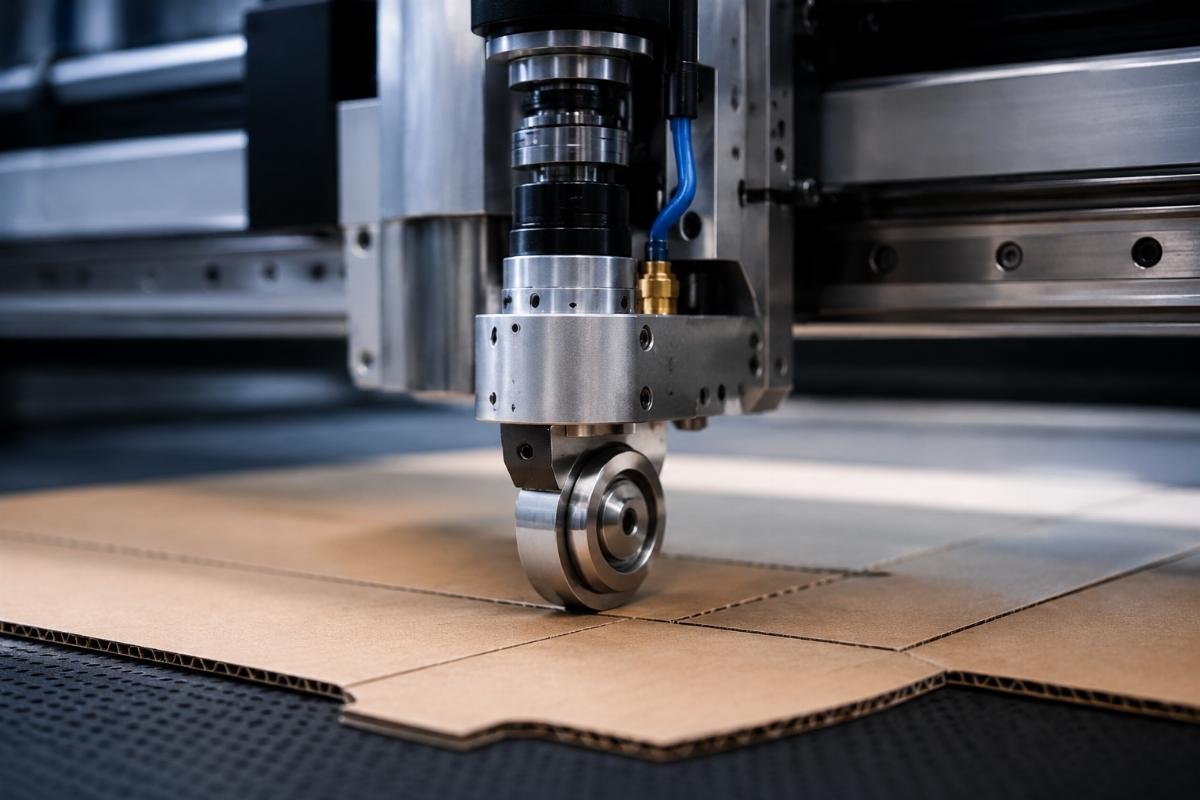
We mount the creasing wheel next to the cutting blade in the same tool head, and the machine automatically swaps tools when the cut file includes crease vectors. The crease wheel applies controlled pressure—typically 50 to 150 kilograms depending on material thickness—into a shallow channel in the cutting mat, which compresses the cardboard fibers without breaking them, so the sheet folds cleanly along that line. Single-wall corrugated needs a 0.8-millimeter-wide creasing wheel, while solid chipboard works better with a 1.2-millimeter wheel because the thicker wheel prevents over-compression that can crack the surface.
Perforations require programming a dash pattern in your CAD file. For a standard tear strip, we cut 5 millimeters, skip 3 millimeters, cut 5 millimeters, and repeat along the line. The skip distance controls how hard someone must pull to separate the pieces—shorter skips make tearing easier but weaken the box during handling, longer skips make tearing harder but keep the box stronger until the customer opens it.
Conclusion
CNC knife cutting suits cardboard packaging when you produce fewer than 500 pieces per design, need fast design changes, or run multiple box styles daily—eliminating die tooling costs and compressing lead times from weeks to minutes, though die-cutting still wins for high-volume identical production.
"Specifications for Corrugated Paperboard", https://www.archives.gov/files/preservation/storage/pdf/corrugated-board.pdf. Industry standards define corrugated board thickness classifications and paperboard weight measurements in gsm (grams per square meter), providing context for CNC cutting machine specifications. Evidence role: definition; source type: education. Supports: standard thickness ranges for corrugated and paperboard materials used in packaging. Scope note: Standards describe material classifications rather than CNC cutting capabilities specifically ↩
"[PDF] Oscillating & Tangential Knife Manual - Multicam", https://multicam.com.au/images/PDF/Oscillating_Tangential_Knifes_Manual.pdf. Research on oscillating knife cutting systems documents blade vibration frequencies and their relationship to cutting quality in flexible materials, supporting the operational parameters described. Evidence role: mechanism; source type: research. Supports: typical oscillation frequencies for industrial CNC knife cutting systems. ↩
"[PDF] Optimum Fiber Distribution in Singlewall Corrugated Fiberboard", https://research.fs.usda.gov/download/treesearch/30515.pdf. Technical references define single-wall corrugated fiberboard as consisting of one fluted medium glued between two flat linerboards, establishing the standard construction described. Evidence role: definition; source type: encyclopedia. Supports: the structural composition of single-wall corrugated board. ↩
"Verified Supplier Steel Rule Cutting Grinding for Precise Cutting", https://www.alibaba.com/showroom/steel-rule-cutting.html. Packaging industry associations report die tooling costs varying by size and complexity, providing market context for custom die fabrication expenses. Evidence role: statistic; source type: institution. Supports: typical cost ranges for steel-rule die fabrication in packaging. Scope note: Costs vary significantly by region, die size, and supplier, making precise ranges difficult to establish ↩
"CNC Knife Cutter vs Die Cutter: Cost, Accuracy, and Efficiency ...", https://www.zxtcutter.com/news/cnc-knife-cutter-vs-die-cutter-cost-accuracy-and-efficiency-compared.html. Manufacturing studies comparing cutting technologies document cycle time differences, though actual speeds vary significantly based on design complexity and material type. Evidence role: statistic; source type: research. Supports: comparative production speeds between die-cutting and CNC knife cutting methods. Scope note: Comparison represents simplified scenarios; actual production speeds depend heavily on specific design parameters ↩
"China An Expert Guide to CNC Cutting Accuracy Tolerance: 5 ...", https://www.yuchon.com/cnc-cutting-accuracy-tolerance-guide/. Technical studies on CNC knife cutting document positioning accuracy and repeatability for various substrates, providing context for tolerance expectations. Evidence role: statistic; source type: research. Supports: achievable dimensional tolerances for CNC knife cutting systems on paper-based materials. Scope note: Actual tolerances depend on material properties, machine calibration, and environmental conditions ↩
"Definitive Guide to Router Vacuum Tables and Pumps ...", https://www.cnccookbook.com/router-vacuum-table-cnc-diy/. Studies on vacuum work-holding systems examine the relationship between suction pressure and material deformation, informing optimal hold-down parameters for thin sheet materials. Evidence role: mechanism; source type: research. Supports: vacuum hold-down requirements for flexible sheet materials during CNC processing. Scope note: Optimal vacuum levels vary by material thickness, porosity, and cutting forces ↩
"Steel rule dies are used to cut thousands of substrates", https://appledie.com/products-steel-rule-dies/. Packaging industry surveys document die fabrication turnaround times, though actual lead times vary by die complexity, supplier capacity, and order priority. Evidence role: statistic; source type: institution. Supports: typical lead times for custom die fabrication in packaging. Scope note: Lead times vary significantly by supplier, die complexity, and production queue ↩
"Cardboard Cnc Cutting Machine(999+) - Alibaba.com", https://www.alibaba.com/showroom/cardboard-cnc-cutting-machine.html. Industry market analyses provide pricing ranges for digital cutting equipment, though costs vary significantly by manufacturer, features, and regional market conditions. Evidence role: statistic; source type: institution. Supports: approximate market pricing for entry-level CNC knife cutting equipment. Scope note: Pricing is highly variable and changes over time; represents approximate entry-level range only ↩
"Understanding the ROI of Packaging Machinery Investments", https://robopacusa.com/understanding-the-roi-of-packaging-machinery-investments/. Industry case studies and financial analyses examine ROI for digital cutting equipment, though actual payback periods depend heavily on production volume, design variety, and operational efficiency. Evidence role: statistic; source type: institution. Supports: typical payback periods for digital cutting technology adoption in packaging. Scope note: ROI calculations are highly specific to individual business models and production scenarios ↩