


Sticker Cutting Machine for Flexible Material – Manufacturer
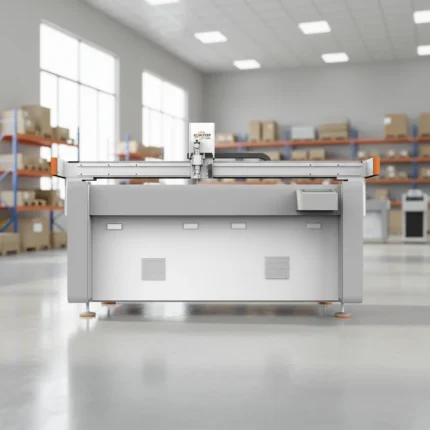
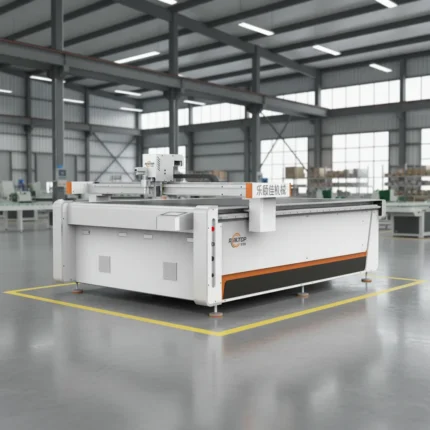
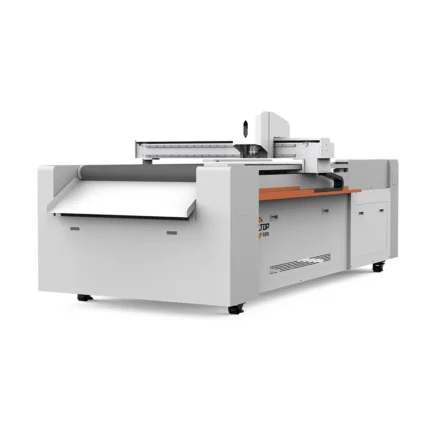
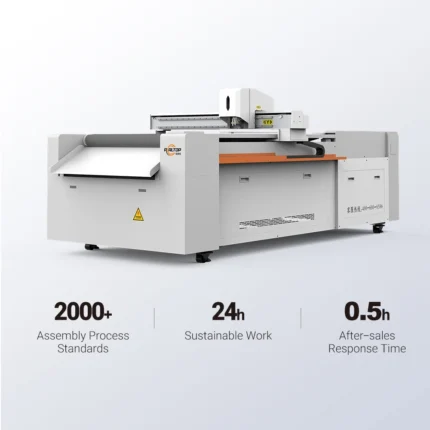
RT-D2516/RT-S2516 CNC Oscillating Knife Cutting Machine, 1600×2500 mm, 7.5 kW Vacuum — configured with Swiss imported oscillating knife head for full-cut, half-cut and kiss-cut operations on stickers, leather, PVC and flexible composites. Zoned vacuum table holds small parts flat during high-speed cutting at 800–1200 mm/s translational velocity. Japanese Yaskawa servo motors and Taiwan Hiwin linear rails deliver ≤0.1 mm repeated accuracy across the work area.
- Cutting method and tool head specified per your material type, thickness and edge quality requirement before order
- Sample cutting on your own sticker stock or flexible material provided for validation prior to commitment
- Voltage, plug type, control language and software file format confirmed to match your production workflow
Specified per material — every tool head, vacuum zone and cutting parameter is matched to your exact sticker stock, leather grade or foam density before the order is confirmed.
Technical Specifications
| Parameter | Value |
|---|---|
| Product Type | CNC Oscillating Knife Cutting Machine |
| Model | RT-D2516/RT-S2516 |
| Working Area | 1600×2500 mm |
| Overall Dimensions (L×W×H) | 3450×2300×1250 mm |
| Rated Power | 9 kW |
| Vacuum Pump | 7.5 kW |
| Table Type | Flat working table with vacuum and auto feeding |
| Tool Head | Swiss imported oscillating knife with vibration full cutting, half cutting and cursor location |
| Translational Velocity | 800–1200 mm/s |
| Cutting Speed | 200–800 mm/s (basis not stated in source — confirm material type and thickness) |
| Repeated Accuracy | ≤0.1 mm |
| Servo Motor | Japanese Yaskawa digital servo |
| Linear Rail | Taiwan Hiwin |
| Conveyor Belt | Germany imported |
| Transmission System | Digital servo motor, linear guide, synchronous belt, ball screw |
| Instruction System | HP-GL compatible format |
| Voltage | 380V ±10% |
| Safety Device | Infrared sensors |
| Standards | CE |
| Warranty | 12 months for whole machine, 3 months for consumables |
Application Suitability
| Application | Material or Output |
|---|---|
| Sticker and mobile phone accessory die-cutting | Self-adhesive vinyl, PET films, paper-based labels requiring half-cut and kiss-cut |
| Leather and garment material processing | Natural leather, PU leather, flexible textiles for shoe uppers and apparel panels |
| Flexible composite and foam conversion | Sponge composite leather, EVA foam, EPDM gaskets, corrugated packaging inserts |
| PVC and soft glass fabrication | Flexible PVC sheets, transparent soft glass for protective covers and curtains |
| Rubber and silicon gasket production | Silicone sheets, neoprene, nitrile rubber for industrial seals |
Why "200 to 800 mm/s" Means Nothing Without Your Material
Cutting speed is a result, not a setting — it only becomes real once your material, thickness and edge requirement are locked in.
I once configured a CNC knife cutting machine for flexible materials at what looked like a reasonable feed rate on standard sticker stock. The customer’s actual production run used a thicker adhesive-backed composite. The blade couldn’t shear cleanly at that speed, and the adhesive dragged along the cut line, ruining entire sheets. A CNC oscillating knife cutting machine only delivers its published speed range when the tool head, oscillation frequency and vacuum hold-down are all tuned to the specific material running across the table. [NEED_CITE: cutting speed validation protocols for flexible material processing]
Oscillation Modes and What They Actually Cut
The Swiss imported oscillating knife head on this flatbed offers three functional modes: vibration full cutting, vibration half cutting, and cursor location. Full cutting shears completely through sticker laminates and thin leather hides in a single pass. Half cutting — essential for kiss-cut sticker production — scores through the face material while leaving the release liner intact. Cursor location handles contour work where the machine must trace a printed boundary rather than follow a vector file. Each mode changes the effective load on the Yaskawa servo and the stress on the blade, which is why confirming the correct mode for your material matters more than the headline speed figure.
Vacuum Zoning for Small-Part Stability
Sticker sheets and gasket nests produce dozens of small parts per layout. When the cutting head moves at translational speeds up to 1200 mm/s, air displacement alone can lift lightweight pieces off the table surface. The 7.5 kW vacuum pump working across the zoned flat table addresses this by maintaining hold-down pressure in the active cutting zone while allowing spent air to exhaust from cleared zones. Without zoning, small die-cut labels shift mid-pass, producing offset cuts that fail registration checks downstream. [NEED_CITE: vacuum hold-down requirements for small-part CNC flatbed cutting]
Decoding the Motion Stack
The repeated accuracy figure of ≤0.1 mm depends on the entire transmission chain working together. Yaskawa digital servos provide closed-loop position feedback, while Taiwan Hiwin linear rails eliminate the lateral play that synchronous belts alone cannot control. The ball screw drives the Z-axis for precise depth adjustment — critical when switching between a full cut through 3 mm foam and a kiss-cut on a 0.2 mm sticker laminate. Together these components determine whether the twentieth cut in a nesting layout lands in the same position as the first. The HP-GL compatible instruction system accepts nested files from common packaging and signage software, reducing the translation errors that arise when converting between proprietary formats.
What Happens When the Configuration Guess Is Wrong
Choosing a drag knife instead of an oscillating knife for foam or sponge composite leather produces compressed, ragged edges that reject on visual inspection. Specifying insufficient vacuum zoning means small sticker parts lift during high-speed traverses, creating misregistration across the entire sheet. Running a material that exceeds the oscillation frequency range of the selected tool head forces the operator to slow down manually, negating whatever throughput the brochure promised. These failures are not machine defects — they are specification errors that happen when configuration is based on a working area dimension rather than the actual material stack. [NEED_CITE: tool head selection criteria by material type and thickness]
Why Sourcing Here Reduces Configuration Risk
In-house design covers both the knife cutting table and the motion system, so tool head selection is not an afterthought bolted onto a generic frame. The oscillating knife and table configuration is specified per material type and thickness before production begins, not selected from a fixed menu after the machine is built. Sample cutting on the buyer’s own sticker stock, leather hide or foam sheet is completed before the order is finalized, producing a documented cutting report that confirms edge quality, speed and hold-down adequacy. Voltage, plug type and control language are confirmed against the destination market’s standards before the electrical cabinet is wired. Software compatibility — file format, nesting workflow and HP-GL interpretation — is verified so the machine integrates with the buyer’s existing production pipeline on day one.
Documentation & Verification
- Machine specification sheet listing confirmed tool head, vacuum zone layout and cutting parameters
- Electrical schematic with voltage, frequency and plug type matched to destination market
- Sample cutting report on buyer’s sticker, leather or foam material with measured edge quality
- Factory test record documenting repeated accuracy and translational speed under load
- Software licence documentation with HP-GL compatibility and confirmed nesting workflow
- Spare parts list covering blade types, vacuum seals and wear components specific to configuration
Installation, Commissioning & Support
- Floor plan layout for 3450×2300 mm footprint plus material feed and offcut clearance zones
- Dedicated 380V ±10% circuit with isolated ground, sized for combined 9 kW machine and 7.5 kW vacuum pump load
- Frame and table delivered in shipping configuration requiring on-site reassembly of gantry and conveyor
- First-run commissioning with oscillation depth calibration and vacuum zone balancing on buyer’s material
- Operator training covering half-cut depth adjustment, blade change procedure and HP-GL file loading
- Consumable blade inventory and vacuum seal replacements specified to the configured tool head type
Getting the Specification Right Before Quotation
Send your actual material — the specific sticker laminate, leather grade or foam thickness you run in production — along with your typical sheet size and daily volume. Confirm your workshop voltage and frequency, the plug standard required in your market, and the control language your operators need. If you already run nesting software, share the file format and a sample layout so compatibility is verified before the machine enters production.
Frequently Asked Questions
Q: How is cutting speed determined for my specific sticker or flexible material?
A: Published cutting speed ranges are material-dependent, not absolute. We run your actual sticker stock or flexible material on the configured tool head and document the achievable speed with acceptable edge quality in a sample cutting report before the order is confirmed.
Q: Oscillating knife or drag knife — which tool head fits my material?
A: Oscillating knife suits thicker flexible materials like foam, sponge composite leather and gasket rubber where a dragging blade would crush or tear. Drag knife works for thin vinyl and paper. We recommend based on your material type and measured cutting result.
Q: Can the vacuum table hold small sticker parts flat at full traversing speed?
A: The 7.5 kW vacuum pump with zoned flat table maintains localized suction in the active cutting area, preventing small die-cut parts from lifting during high-speed head movement. Zone configuration is matched to your typical nest layout.
Q: What voltage and control language options are available?
A: Standard configuration is 380V ±10%, but voltage and plug type are confirmed against your local supply before the electrical cabinet is built. Control language is specified during the order confirmation stage to match your operator requirements.
Q: Can I send my own material for testing before committing?
A: Yes. Sample cutting on your sticker laminate, leather hide or foam sheet is a standard step in the process. You receive a cutting report documenting edge quality, speed achieved and vacuum hold-down performance before any order is placed.


Related products
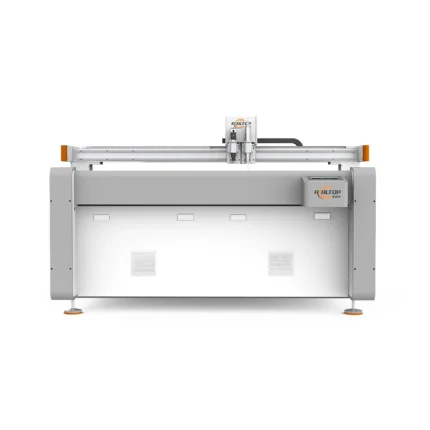
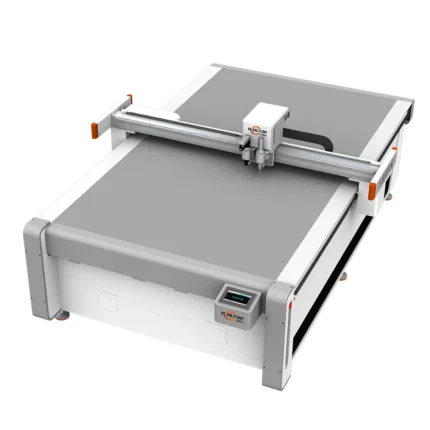
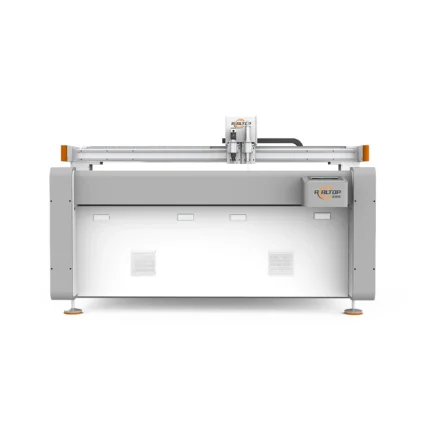
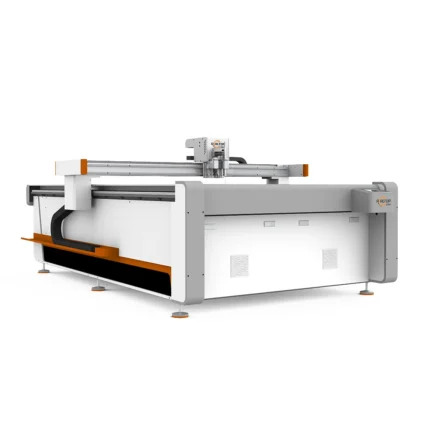

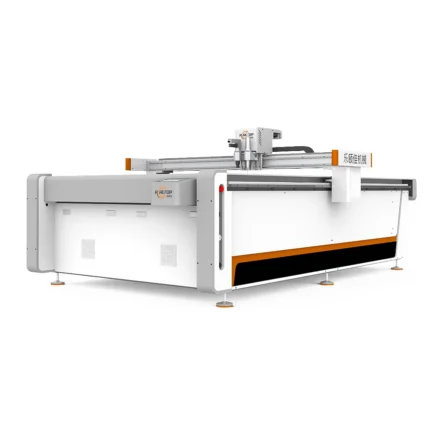
CNC Flatbed Oscillating Knife Cutting Machine 2026
Product Introduction
High-performance CNC Flatbed Oscillating Knife Cutting Machine 2026, ideal for precision cutting of various materials with advanced oscillating knife technology, ensuring efficient and accurate operations for industrial manufacturing needs.Specifications
| Model | 2026 |
| Type | CNC Flatbed Oscillating Knife Cutting Machine |
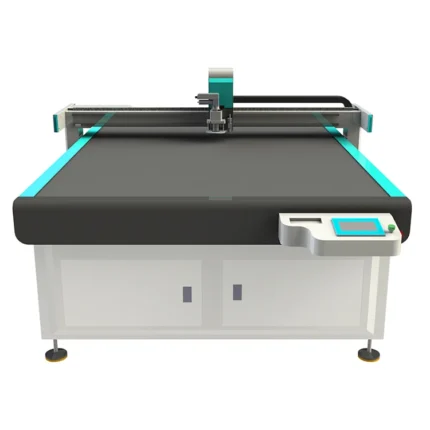
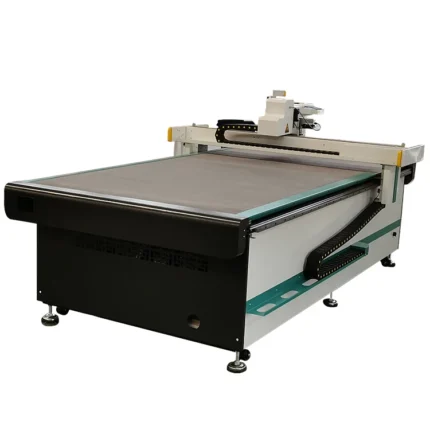
CNC Oscillating Knife Cutting Machine 2026 for Corrugated Cardboard & Honeycomb
Product Introduction
2026 CNC Oscillating Knife Cutting Machine, ideal for corrugated cardboard and honeycomb materials, offering precise and efficient cutting solutions for your production needs.Specifications
| Model | 2026 |
| Type | CNC Oscillating Knife Cutting Machine |
| Applicable Materials | Corrugated Cardboard, Honeycomb |
| Cutting Method | Oscillating Knife |

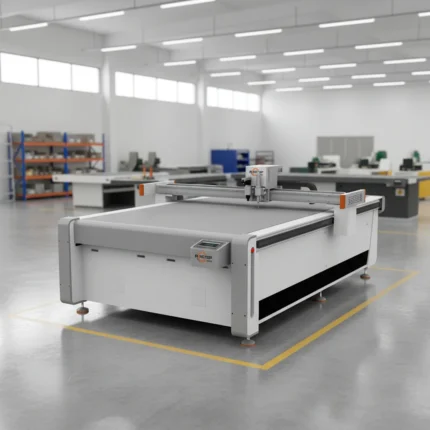


Digital CNC Cardboard Cutting Machine 2026
Product Introduction
High-precision Digital CNC Cardboard Cutting Machine 2026, ideal for efficient cardboard processing with advanced CNC technology, ensuring precise and fast cutting performance for various packaging and craft applications.
Key Specifications
| Model | 2026 |
| Type | Digital CNC Cutting Machine |
| Material | Cardboard |
| Feature | High Precision, Efficient Cutting |
商品评价
There are no reviews yet.